


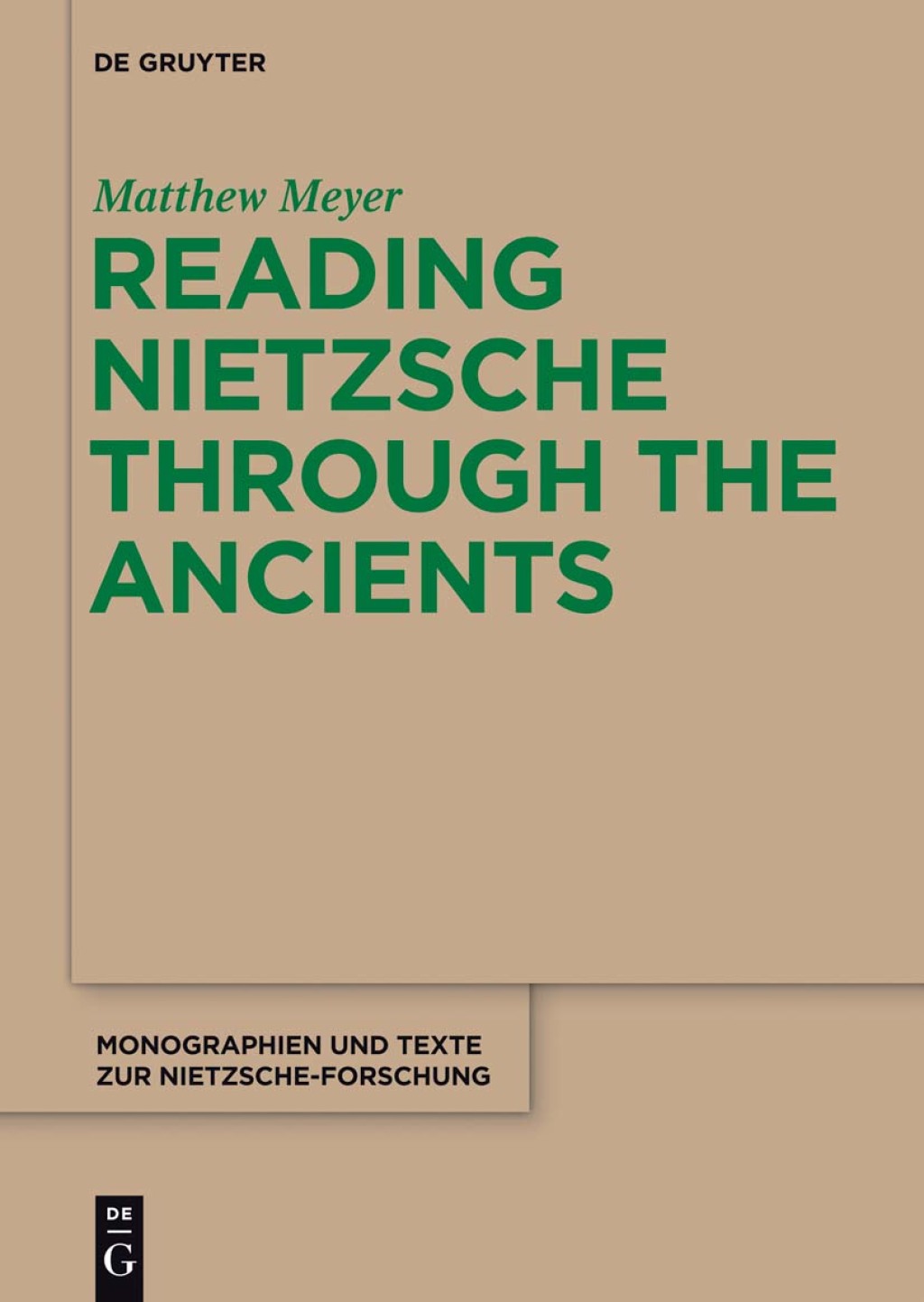
Reading Nietzsche through the Ancients An Analysis of Becoming, Perspectivism, and the Principle of Non-Contradiction 1st Edition – PDF/EPUB Version Downloadable
$49.99
Author(s): Matthew Meyer
Publisher: De Gruyter
ISBN: 9781934078419
Edition: 1st Edition
Nietzsche’s work was shaped by his engagement with ancient Greek philosophy. Matthew Meyer analyzes Nietzsche’s concepts of becoming and perspectivism and his alleged rejection of the principle of non-contradiction, and he traces these views back to the Heraclitean-Protagorean position that Plato and Aristotle critically analyze in the Theaetetus and Metaphysica IV, respectively. At the center of this Heraclitean-Protagorean position is a relational ontology in which everything exists and is what it is only in relation to something else. Meyer argues that this relational ontology is not only theoretically foundational for Nietzsche’s philosophical project, in that it is the common element in Nietzsche’s views on becoming, perspectivism, and the principle of non-contradiction, but also textually foundational, in that Nietzsche implicitly commits himself to such an ontology in raising the question of opposites at the beginning of both Human, All Too Human and Beyond Good and Evil.
Related products





Reading Nietzsche through the Ancients An Analysis of Becoming, Perspectivism, and the Principle of Non-Contradiction 1st Edition – PDF/EPUB Version Downloadable
$49.99
Author(s): Matthew Meyer
Publisher: De Gruyter
ISBN: 9781934078419
Edition: 1st Edition
Nietzsche’s work was shaped by his engagement with ancient Greek philosophy. Matthew Meyer analyzes Nietzsche’s concepts of becoming and perspectivism and his alleged rejection of the principle of non-contradiction, and he traces these views back to the Heraclitean-Protagorean position that Plato and Aristotle critically analyze in the Theaetetus and Metaphysica IV, respectively. At the center of this Heraclitean-Protagorean position is a relational ontology in which everything exists and is what it is only in relation to something else. Meyer argues that this relational ontology is not only theoretically foundational for Nietzsche’s philosophical project, in that it is the common element in Nietzsche’s views on becoming, perspectivism, and the principle of non-contradiction, but also textually foundational, in that Nietzsche implicitly commits himself to such an ontology in raising the question of opposites at the beginning of both Human, All Too Human and Beyond Good and Evil.