
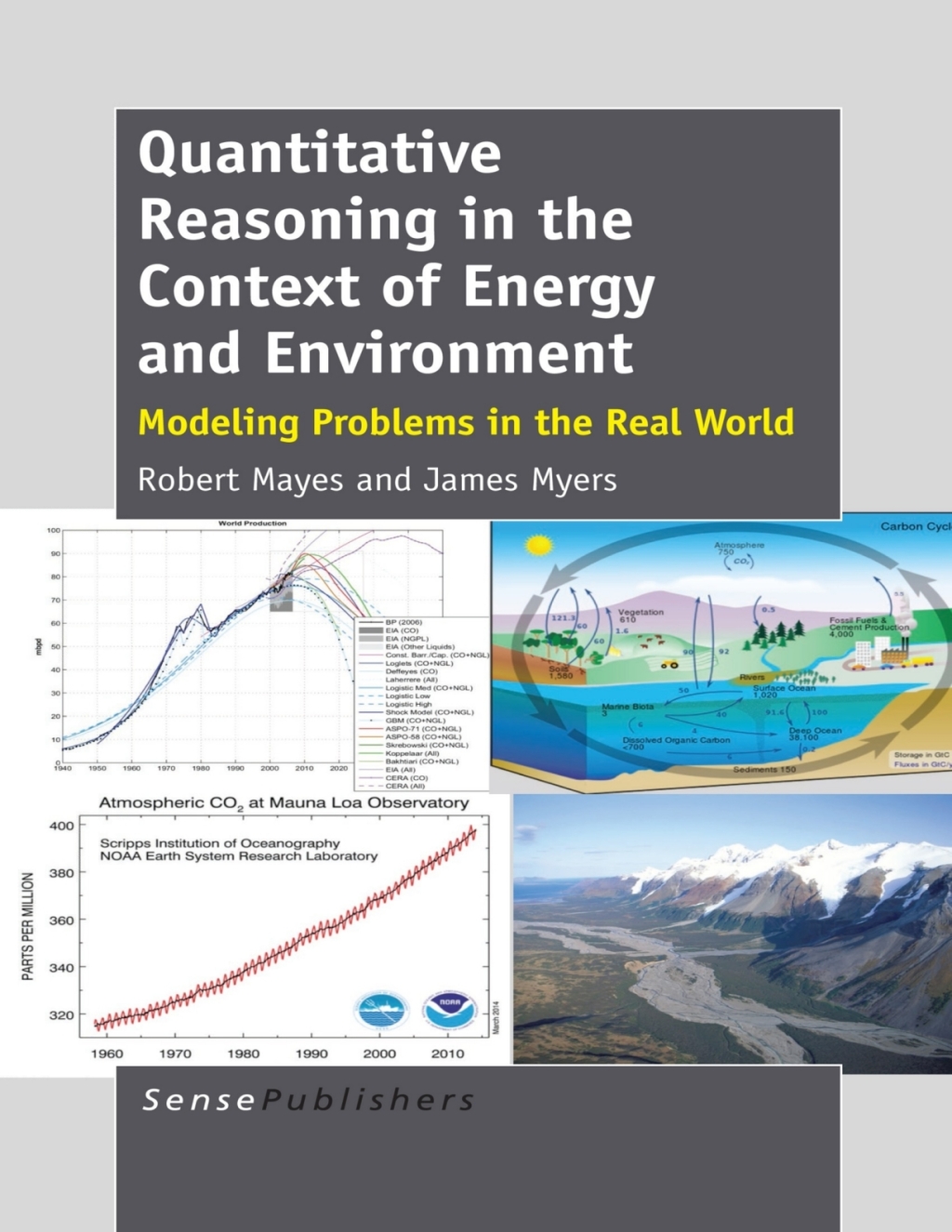
Quantitative Reasoning in the Context of Energy and Environment Modeling Problems in the Real World – PDF/EPUB Version Downloadable
$49.99
Author(s): Robert Mayes; James Myers
Publisher: SensePublishers
ISBN: 9789462095274
Edition:
This book provides professional development leaders and teachers with a framework for integrating authentic real-world performance tasks into science, technology, engineering, and mathematics (STEM) classrooms. We incorporate elements of problem-based learning to engage students around grand challenges in energy and environment, place-based leaning to motivate students by relating the problem to their community, and Understanding by Design to ensure that understanding key concepts in STEM is the outcome. Our framework has as a basic tenet interdisciplinary STEM approaches to studying real-world problems. We invited professional learning communities of science and mathematics teachers to bring multiple lenses to the study of these problems, including the sciences of biology, chemistry, earth systems and physics, technology through data collection tools and computational science modeling approaches, engineering design around how to collect data, and mathematics through quantitative reasoning. Our goal was to have teachers create opportunities for their students to engage in real-world problems impacting their place; problems that could be related to STEM grand challenges demonstrating the importance and utility of STEM. We want to broaden the participation of students in STEM, which both increases the future STEM workforce, providing our next generation of scientists, technologists, engineers, and mathematicians, as well as producing a STEM literate citizenry that can make informed decisions about grand challenges that will be facing their generation. While we provide a specifi c example of an interdisciplinary STEM module, we hope to do more than provide a single fish. Rather we hope to teach you how to fish so you can create modules that will excite your students.