
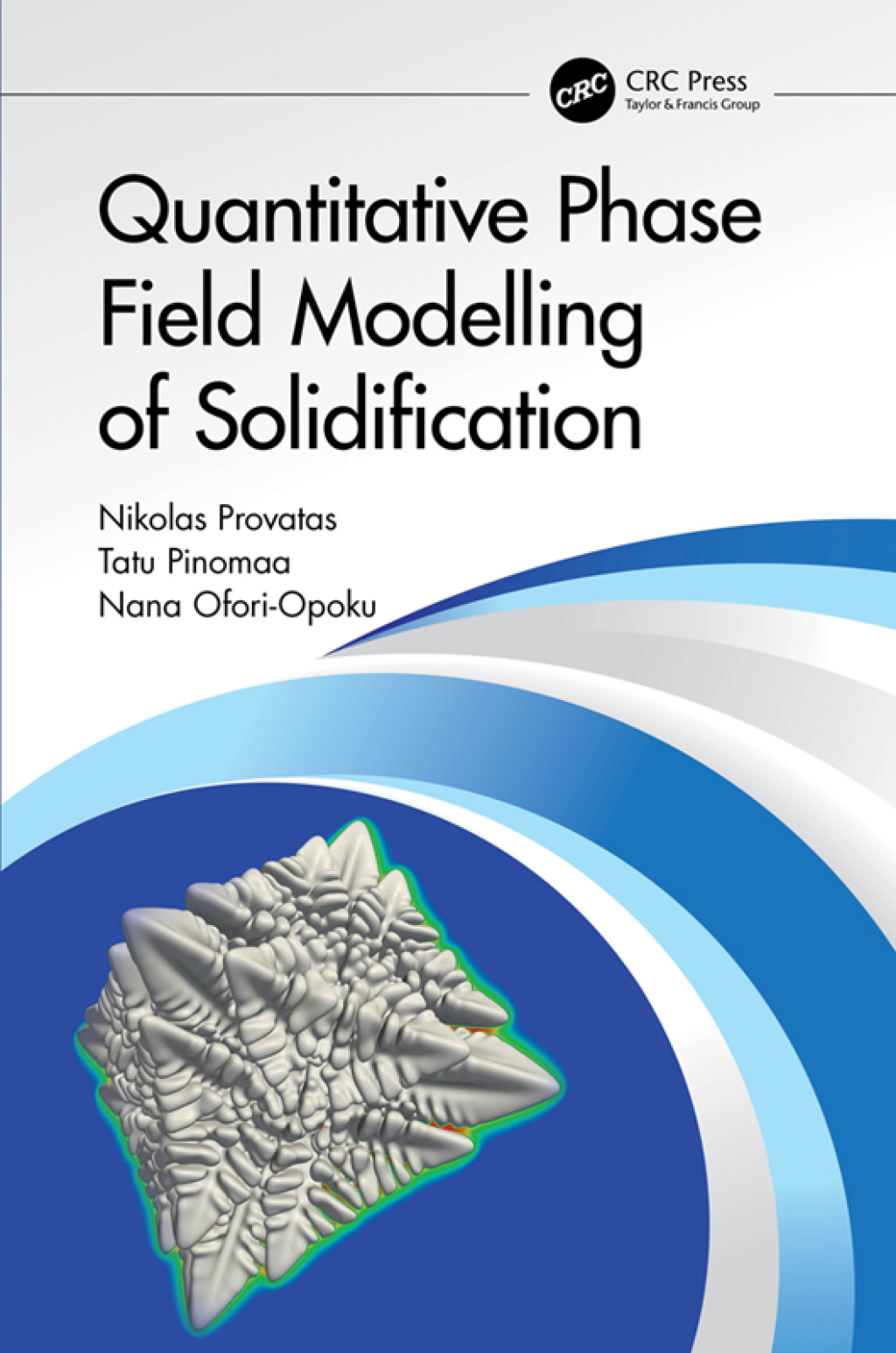
Quantitative Phase Field Modelling of Solidification 1st Edition – PDF/EPUB Version Downloadable
$49.99
Author(s): Nikolas Provatas; Tatu Pinomaa; Nana Ofori-Opoku
Publisher: CRC Press
ISBN: 9780367768577
Edition: 1st Edition
This book presents a study of phase field modelling of solidification in metal alloy systems. It is divided in two main themes. The first half discusses several classes of quantitative multi-order parameter phase field models for multi-component alloy solidification. These are derived in grand potential ensemble, thus tracking solidification in alloys through the evolution of the chemical potentials of solute species rather than the more commonly used solute concentrations. The use of matched asymptotic analysis for making phase field models quantitative is also discussed at length, and derived in detail in order to make this somewhat abstract topic accessible to students. The second half of the book studies the application of phase field modelling to rapid solidification where solute trapping and interface undercooling follow highly non-equilibrium conditions. In this limit, matched asymptotic analysis is used to map phase field evolution equations onto the continuous growth model, which is generally accepted as a sharp-interface description of solidification at rapid solidification rates. This book will be of interest to graduate students and researchers in materials science and materials engineering. Key Features Presents a clear path to develop quantitative multi-phase and multi-component phase field models for solidification and other phase transformation kinetics Derives and discusses the quantitative nature of the model formulations through matched interface asymptotic analysis Explores a framework for quantitative treatment of rapid solidification to control solute trapping and solute drag dynamics