
![Problems and Materials on Payment Law [Connected eBook with Study Center] 12th Edition – PDF/EPUB Version Downloadable](https://2025cloudcore.nyc3.digitaloceanspaces.com/problems-and-materials-on-payment-law-[connected-ebook-with-study-center]-12th-edition-%E2%80%93-pdfepub-version-downloadable-1580-js6lt.jpg)
![Problems and Materials on Secured Transactions [Connected eBook with Study Center] 12th Edition – PDF/EPUB Version Downloadable](https://2025cloudcore.nyc3.digitaloceanspaces.com/problems-and-materials-on-secured-transactions-[connected-ebook-with-study-center]-12th-edition-%E2%80%93-pdfepub-version-downloadable-7134-fszbk.jpg)
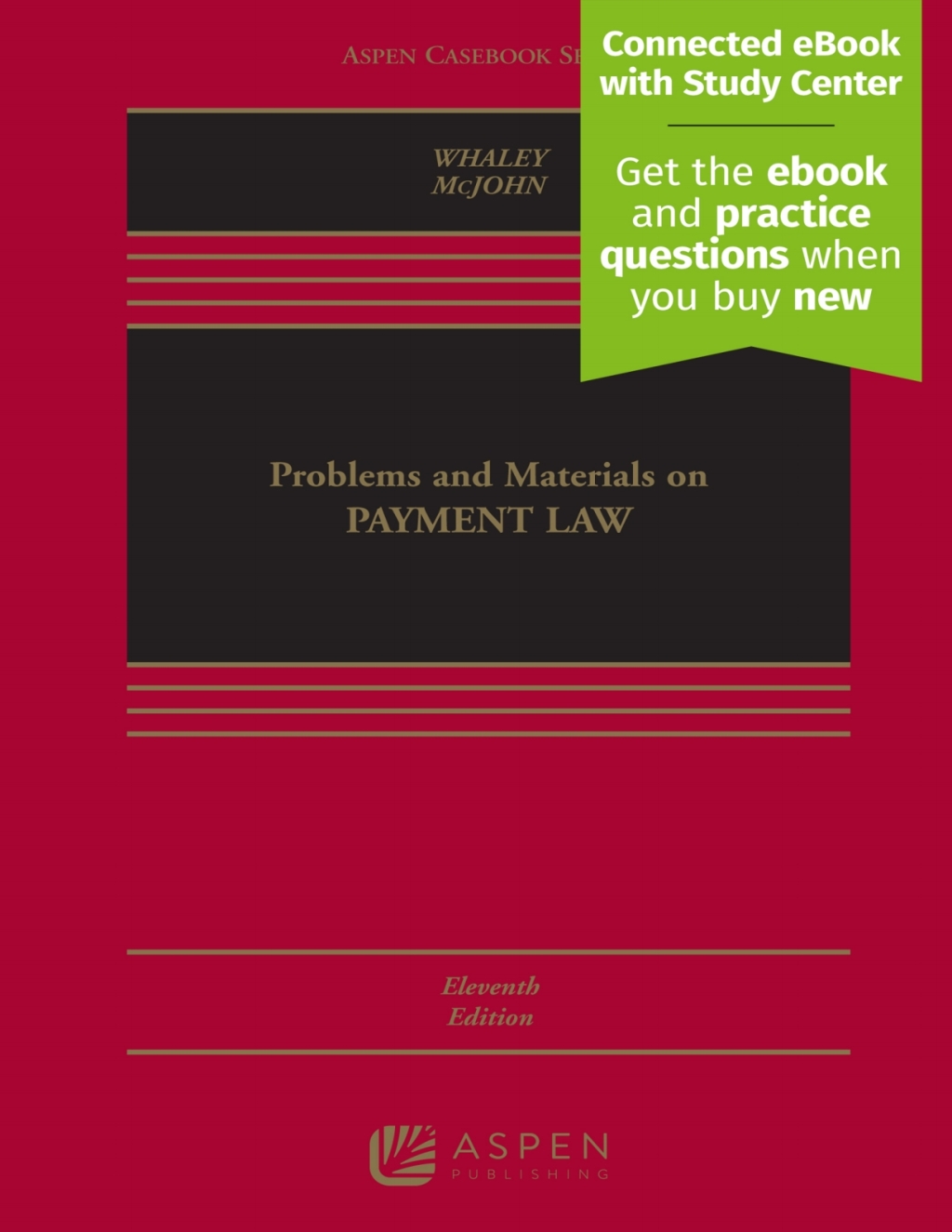
Problems and Materials on Payment Law 11th Edition – PDF/EPUB Version Downloadable
$49.99
Author(s): Douglas J. Whaley; Stephen M. McJohn
Publisher: Aspen Publishing
ISBN: 9781543824407
Edition: 11th Edition
With this courseware purchase, you will receive access to the Connected eBook on CasebookConnect, including: lifetime access to the online ebook with highlight, annotation, and search capabilities; practice questions from your favorite study aids; an outline tool and other helpful resources. Connected eBooks provide what you need most to be successful in your law school classes.
Clear, lucid, and extremely accessible, Problems and Materials on Payment Law, Eleventh Edition helps students understand black letter law and the statutory language in the Uniform Commercial Code, the Electronic Fund Transfer Act, and the Expedited Funds Availability Act. Offering a sensible, flexible organization, the text follows the order of UCC Articles 3, 4, 4A, and 8, and is adaptable to many teaching styles. Drawing on experience in both teaching and writing, the authors provide thorough and practical coverage using a popular problems approach. The text’s effective format, manageable length, and inclusion of the most important cases make Problems and Materials on Payment Law a highly teachable book.
New to the Eleventh Edition:
- Updated rules on check imaging and collection are covered in some detail.
- New cases, including DZ Bank AG Deutche Zentral-Genossenschaftsbank v. McCranie; Majestic Building Maintenance, Inc. v. Huntington Bancshares Inc.; Wesseling v. Brackmann; Auto Sision, Inc. v. Wells Fargo; Peter E. Shapiro P.A. v. Wells Fargo Bank, N.A.; Knop v. Knop; and Cheatham I.R.A. v. Huntington National Bank
- Additional and expanded problems
Professors and students will benefit from:
- Thorough and up-to-date coverage, including the Electronic Funds Transfer Act and Expedited Funds Transfer Act
- Flexible organization—adaptable to many different teaching styles or custom projects
- Multiple-choice questions at the end of each chapter—with analysis for each answer, so students can evaluate why the “right” choice works best
- Basic intro to the UCC for students who are unfamiliar with it, especially as it relates to payment law
- Popular “Problems” approach—is easy for students to utilize when studying, and facilitates better in-classroom understanding during discussions
-1st-edition-%E2%80%93-pdfepub-version-downloadable-4292-c4gaw.jpg)