
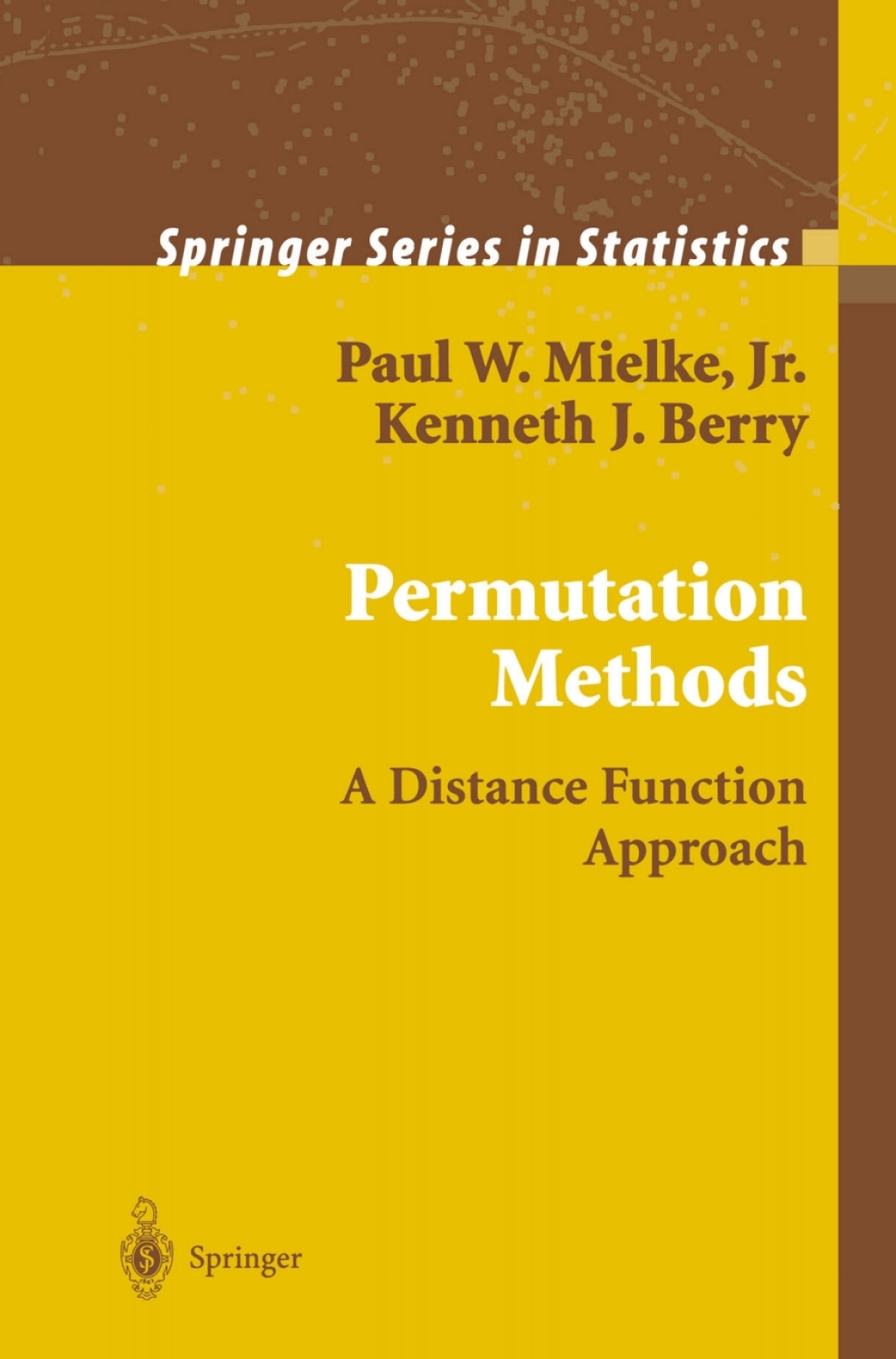
Permutation Methods A Distance Function Approach – PDF/EPUB Version Downloadable
$49.99
Author(s): Paul W. Jr. Mielke Jr.; Kenneth J. Berry
Publisher: Springer
ISBN: 9780387988825
Edition:
The introduction of permutation tests by R. A. Fisher relaxed the paramet ric structure requirement of a test statistic. For example, the structure of the test statistic is no longer required if the assumption of normality is removed. The between-object distance function of classical test statis tics based on the assumption of normality is squared Euclidean distance. Because squared Euclidean distance is not a metric (i. e. , the triangle in equality is not satisfied), it is not at all surprising that classical tests are severely affected by an extreme measurement of a single object. A major purpose of this book is to take advantage of the relaxation of the struc ture of a statistic allowed by permutation tests. While a variety of distance functions are valid for permutation tests, a natural choice possessing many desirable properties is ordinary (i. e. , non-squared) Euclidean distance. Sim ulation studies show that permutation tests based on ordinary Euclidean distance are exceedingly robust in detecting location shifts of heavy-tailed distributions. These tests depend on a metric distance function and are reasonably powerful for a broad spectrum of univariate and multivariate distributions. Least sum of absolute deviations (LAD) regression linked with a per mutation test based on ordinary Euclidean distance yields a linear model analysis which controls for type I error.
-1st-edition-%E2%80%93-pdfepub-version-downloadable-8741-yaq5g.jpg)