
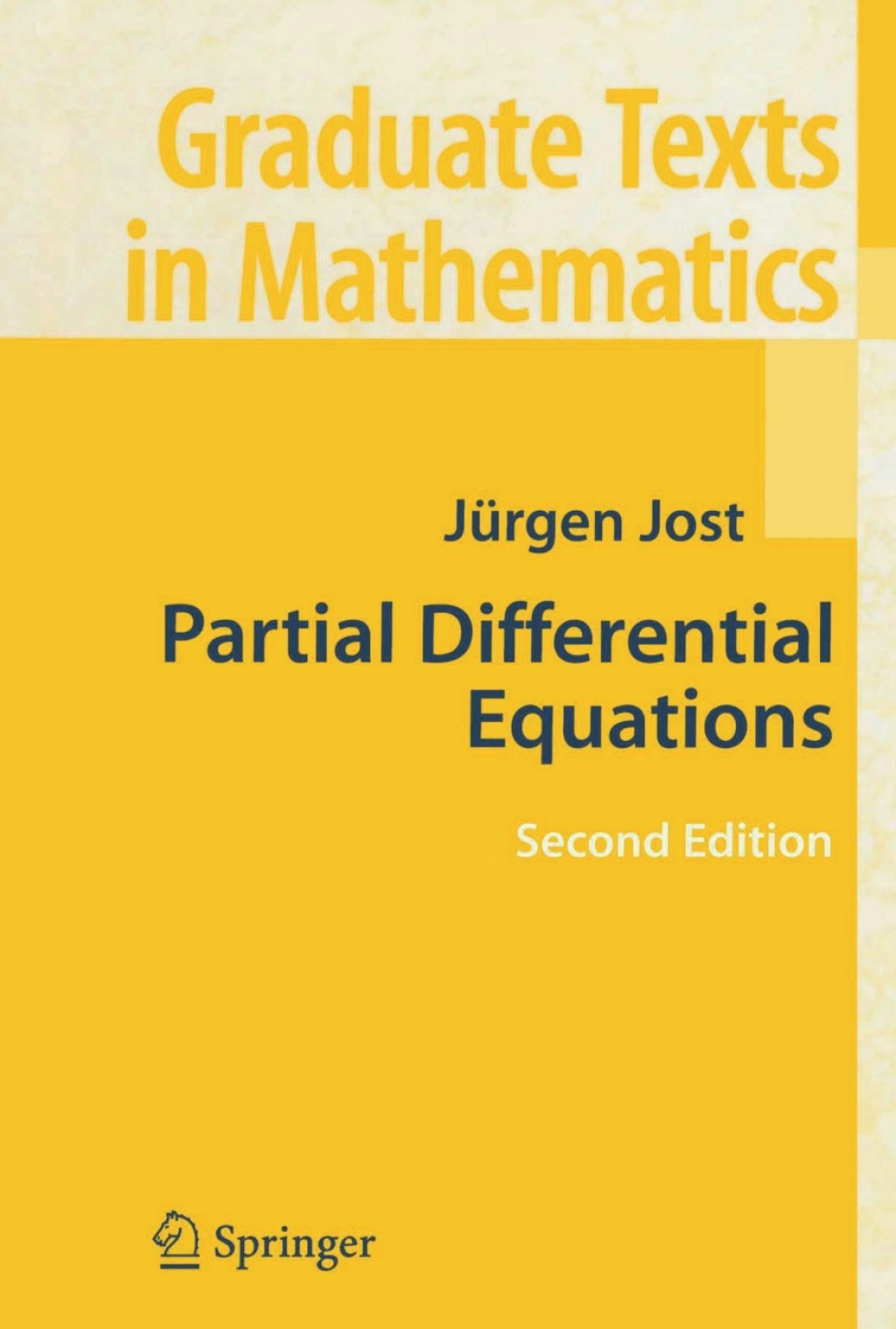
Partial Differential Equations 2nd Edition – PDF/EPUB Version Downloadable
$49.99
Author(s): Jürgen Jost
Publisher: Springer
ISBN: 9780387493183
Edition: 2nd Edition
This textbook is intended for students who wish to obtain an introduction to the theory of partial di?erential equations (PDEs, for short), in particular, those of elliptic type. Thus, it does not o?er a comprehensive overview of the whole ?eld of PDEs, but tries to lead the reader to the most important methods and central results in the case of elliptic PDEs. The guiding qu- tion is how one can ?nd a solution of such a PDE. Such a solution will, of course, depend on given constraints and, in turn, if the constraints are of the appropriate type, be uniquely determined by them. We shall pursue a number of strategies for ?nding a solution of a PDE; they can be informally characterized as follows: (0) Write down an explicit formula for the solution in terms of the given data (constraints). This may seem like the best and most natural approach, but this is possible only in rather particular and special cases. Also, such a formula may be rather complicated, so that it is not very helpful for detecting qualitative properties of a solution. Therefore, mathematical analysis has developed other, more powerful, approaches. (1) Solve a sequence of auxiliary problems that approximate the given one, and show that their solutions converge to a solution of that original pr- lem. Di?erential equations are posed in spaces of functions, and those spaces are of in?nite dimension.
Related products
-1st-edition-%E2%80%93-pdfepub-version-downloadable-8741-yaq5g.jpg)





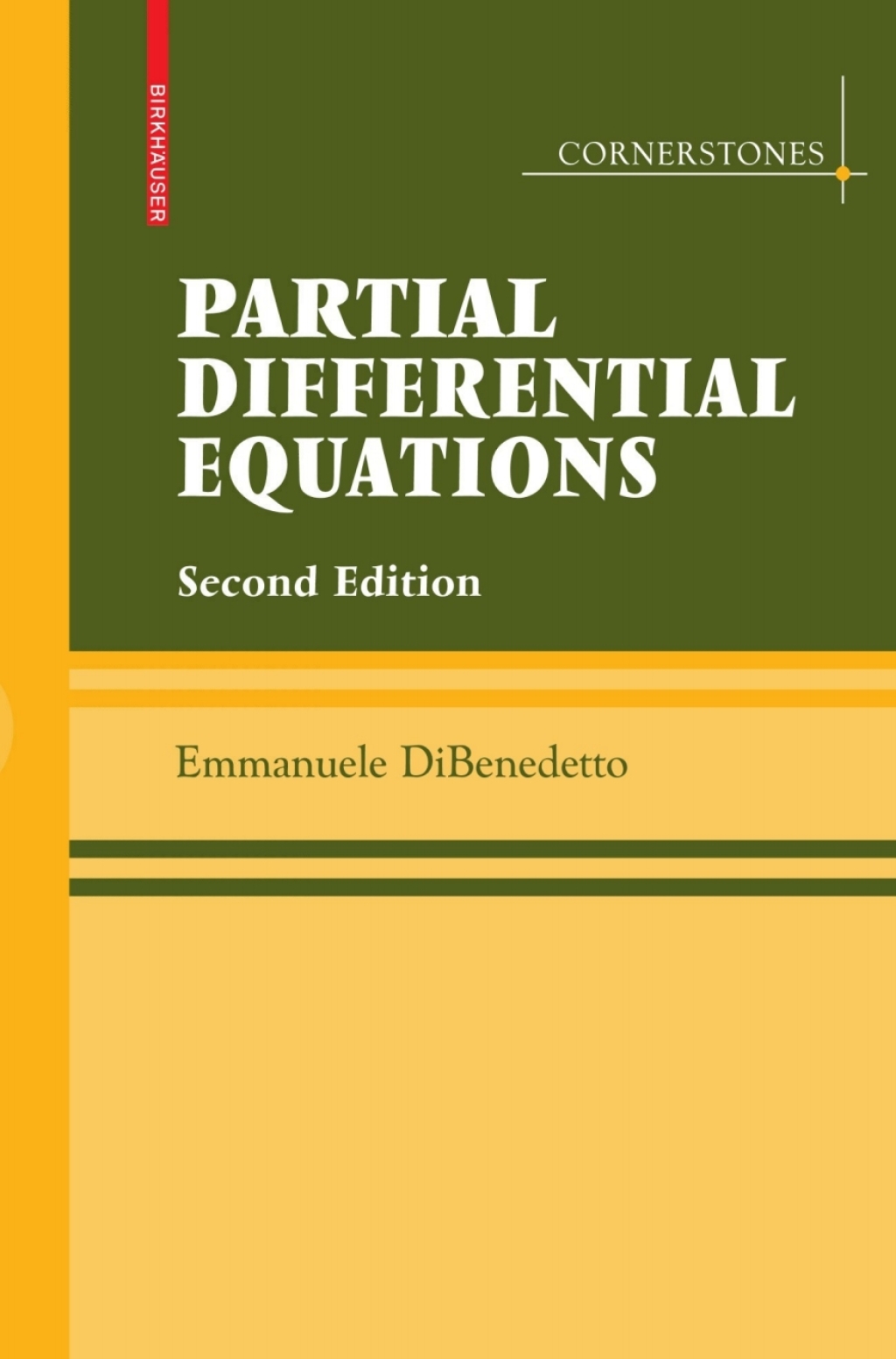

Partial Differential Equations 2nd Edition – PDF/EPUB Version Downloadable
$49.99
Author(s): Emmanuele DiBenedetto
Publisher: Birkhäuser
ISBN: 9780817645519
Edition: 2nd Edition
This is a revised and extended version of my 1995 elementary introduction to partial di?erential equations. The material is essentially the same except for three new chapters. The ?rst (Chapter 8) is about non-linear equations of ?rst order and in particular Hamilton–Jacobi equations. It builds on the continuing idea that PDEs, although a branch of mathematical analysis, are closely related to models of physical phenomena. Such underlying physics in turn provides ideas of solvability. The Hopf variational approach to the Cauchy problem for Hamilton–Jacobi equations is one of the clearest and most incisive examples of such an interplay. The method is a perfect blend of classical mechanics, through the role and properties of the Lagrangian and Hamiltonian, and calculus of variations. A delicate issue is that of identifying “uniqueness classes. †An e?ort has been made to extract the geometrical conditions on the graph of solutions, such as quasi-concavity, for uniqueness to hold. Chapter 9 is an introduction to weak formulations, Sobolev spaces, and direct variationalmethods for linear and quasi-linearelliptic equations. While terse, the material on Sobolev spaces is reasonably complete, at least for a PDEuser. Itincludesallthebasicembeddingtheorems,includingtheirproofs, and the theory of traces. Weak formulations of the Dirichlet and Neumann problems build on this material. Related variational and Galerkin methods, as well as eigenvalue problems, are presented within their weak framework.