
Optimal Control – PDF/EPUB Version Downloadable
$49.99
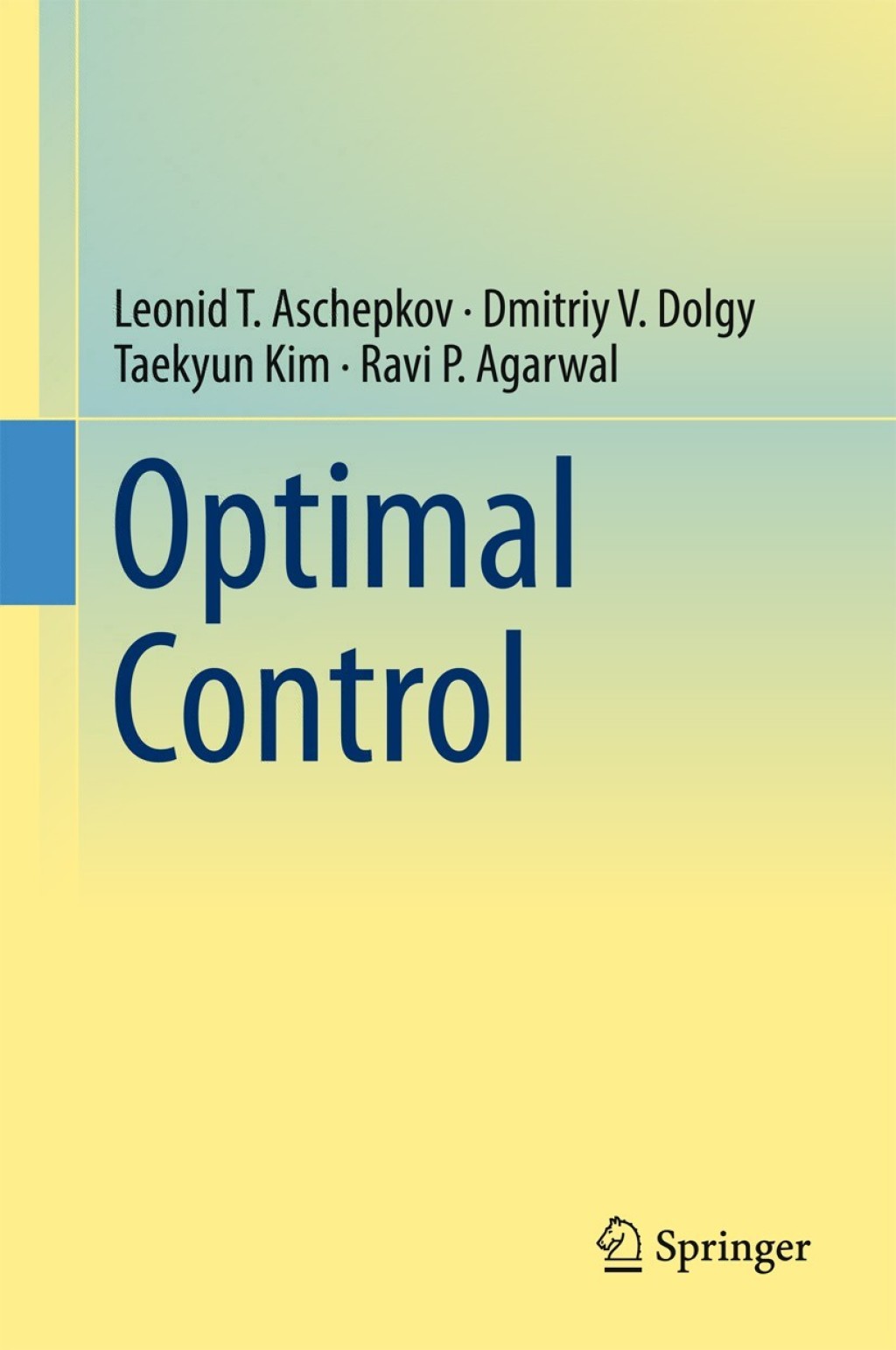
Author(s): Leonid T. Aschepkov; Dmitriy V. Dolgy; Taekyun Kim; Ravi P. Agarwal
Publisher: Springer
ISBN: 9783319497808
Edition:
This book is based on lectures from a one-year course at the Far Eastern Federal University (Vladivostok, Russia) as well as on workshops on optimal control offered to students at various mathematical departments at the university level. The main themes of the theory of linear and nonlinear systems are considered, including the basic problem of establishing the necessary and sufficient conditions of optimal processes. In the first part of the course, the theory of linear control systems is constructed on the basis of the separation theorem and the concept of a reachability set. The authors prove the closure of a reachability set in the class of piecewise continuous controls, and the problems of controllability, observability, identification, performance and terminal control are also considered. The second part of the course is devoted to nonlinear control systems. Using the method of variations and the Lagrange multipliers rule of nonlinear problems, the authors prove the Pontryagin maximum principle for problems with mobile ends of trajectories. Further exercises and a large number of additional tasks are provided for use as practical training in order for the reader to consolidate the theoretical material.
Related products
-1st-edition-%E2%80%93-pdfepub-version-downloadable-4292-c4gaw.jpg)


Optimal Control – PDF/EPUB Version Downloadable
$49.99
Author(s): Richard Vinter
Publisher: Birkhäuser
ISBN: 9780817640750
Edition:
“Each chapter contains a well-written introduction and notes. They include the author’s deep insights on the subject matter and provide historical comments and guidance to related literature. This book may well become an important milestone in the literature of optimal control.” —Mathematical Reviews “Thanks to a great effort to be self-contained, [this book] renders accessibly the subject to a wide audience. Therefore, it is recommended to all researchers and professionals interested in Optimal Control and its engineering and economic applications. It can serve as an excellent textbook for graduate courses in Optimal Control (with special emphasis on Nonsmooth Analysis).” —Automatica “The book may be an essential resource for potential readers, experts in control and optimization, as well as postgraduates and applied mathematicians, and it will be valued for its accessibility and clear exposition.” —Applications of Mathematics