

Numerical Methods for Partial Differential Equations: Finite Difference and Finite Volume Methods – PDF/EPUB Version Downloadable
$49.99
Author(s): Mazumder, Sandip
Publisher: Academic Press
ISBN: 9780128034842
Edition:
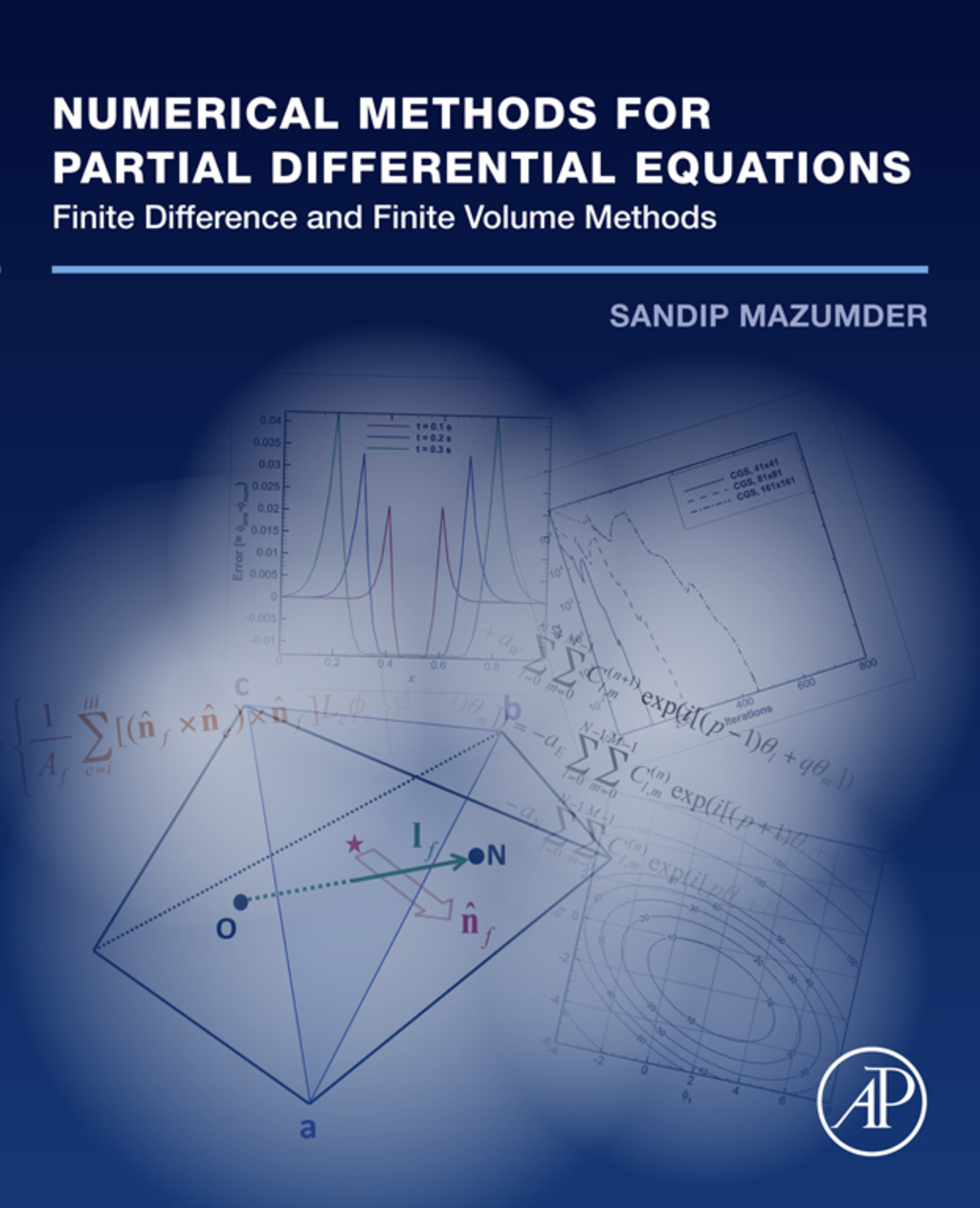
Numerical Methods for Partial Differential Equations: Finite Difference and Finite Volume Methods focuses on two popular deterministic methods for solving partial differential equations (PDEs), namely finite difference and finite volume methods. The solution of PDEs can be very challenging, depending on the type of equation, the number of independent variables, the boundary, and initial conditions, and other factors. These two methods have been traditionally used to solve problems involving fluid flow.
For practical reasons, the finite element method, used more often for solving problems in solid mechanics, and covered extensively in various other texts, has been excluded. The book is intended for beginning graduate students and early career professionals, although advanced undergraduate students may find it equally useful.
The material is meant to serve as a prerequisite for students who might go on to take additional courses in computational mechanics, computational fluid dynamics, or computational electromagnetics. The notations, language, and technical jargon used in the book can be easily understood by scientists and engineers who may not have had graduate-level applied mathematics or computer science courses.
- Presents one of the few available resources that comprehensively describes and demonstrates the finite volume method for unstructured mesh used frequently by practicing code developers in industry
- Includes step-by-step algorithms and code snippets in each chapter that enables the reader to make the transition from equations on the page to working codes
- Includes 51 worked out examples that comprehensively demonstrate important mathematical steps, algorithms, and coding practices required to numerically solve PDEs, as well as how to interpret the results from both physical and mathematic perspectives
-1st-edition-%E2%80%93-pdfepub-version-downloadable-8741-yaq5g.jpg)