
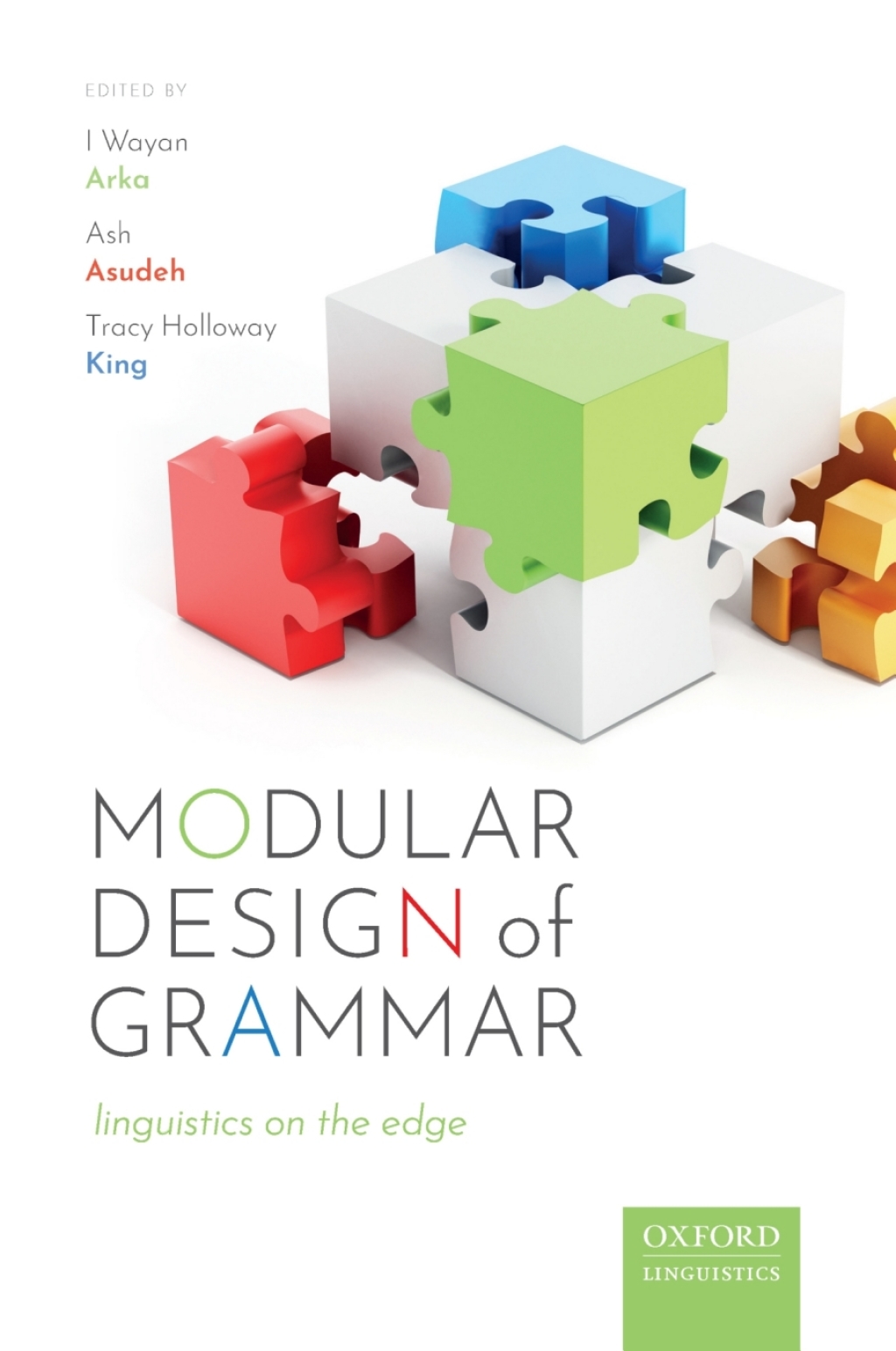


Modular Design of Grammar – PDF/EPUB Version Downloadable
$49.99
Author(s): Author
Publisher: OUP Oxford
ISBN: 9780192844842
Edition:
This volume presents the latest research in linguistic modules and interfaces in Lexical-Functional Grammar (LFG). LFG has a highly modular design that models the linguistic system as a set of discreet submodules that include, among others, constituent structure, functional structure, argument structure, semantic structure, and prosodic structure; each module has its own coherent properties and is related to other modules by correspondence functions. Following a detailed introduction, Part I examines the nature of linguistic structures, interfaces, and representations in LFG’s architecture and ontology. Parts II and III are concerned with problems, analyses, and generalizations associated with linguistic phenomena of long-standing theoretical significance, including agreement, reciprocals, possessives, reflexives, raising, subjecthood, and relativization, demonstrating how these phenomena can be naturally accounted for within LFG’s modular architecture. Part IV explores issues of the synchronic and diachronic dynamics of syntactic categories in grammar, such as unlike category coordination, fuzzy categorial edges, and consequences of decategorialization, providing explicit LFG solutions to such problems, including those resulting from language change in progress. The final part re-examines and refines the precise representations and interfaces of syntax with morphology, semantics, and pragmatics to account for challenging facts such as suspended affixation, prosody in multiple question word interrogatives and information structure, anaphoric dependencies, and idioms. The volume draws on data from a range of typologically diverse languages, including Arabic, Chinese, Icelandic, Kelabit, Polish, and Urdu, and will be of interest not only to those working in LFG and related frameworks, but to all those working on linguistic interfaces from a variety of theoretical standpoints.