
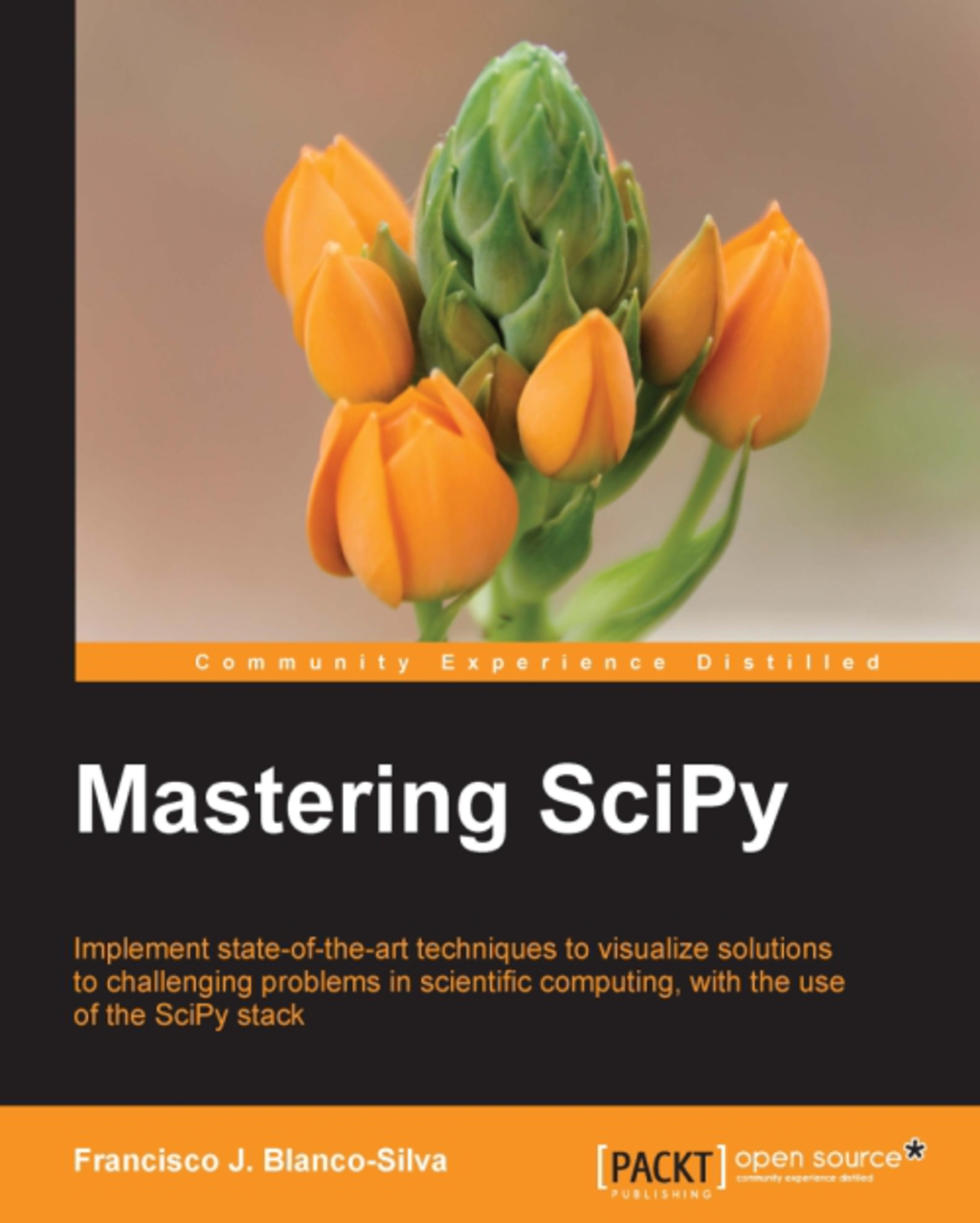

Mastering SciPy 1st Edition – PDF/EPUB Version Downloadable
$49.99
Author(s): Francisco Javier Blanco-Silva
Publisher: Packt Publishing
ISBN: 9781783984749
Edition: 1st Edition
Implement state-of-the-art techniques to visualize solutions to challenging problems in scientific computing, with the use of the SciPy stack
Key Features
Book Description
The SciPy stack is a collection of open source libraries of the powerful scripting language Python, together with its interactive shells. This environment offers a cutting-edge platform for numerical computation, programming, visualization and publishing, and is used by some of the world’s leading mathematicians, scientists, and engineers. It works on any operating system that supports Python and is very easy to install, and completely free of charge! It can effectively transform into a data-processing and system-prototyping environment, directly rivalling MATLAB and Octave.
This book goes beyond a mere description of the different built-in functions coded in the libraries from the SciPy stack. It presents you with a solid mathematical and computational background to help you identify the right tools for each problem in scientific computing and visualization. You will gain an insight into the best practices with numerical methods depending on the amount or type of data, properties of the mathematical tools employed, or computer architecture, among other factors.
The book kicks off with a concise exploration of the basics of numerical linear algebra and graph theory for the treatment of problems that handle large data sets or matrices. In the subsequent chapters, you will delve into the depths of algorithms in symbolic algebra and numerical analysis to address modeling/simulation of various real-world problems with functions (through interpolation, approximation, or creation of systems of differential equations), and extract their representing features (zeros, extrema, integration or differentiation).
Lastly, you will move on to advanced concepts of data analysis, image/signal processing, and computational geometry.
What you will learn
- Master relevant algorithms used in symbolic or numerical mathematics to address the approximation, interpolation, and optimization of scalar or multivariate functions
- Develop different algorithms and strategies to effectively store and manipulate large matrices of data, with a view to solving various problems in numerical linear algebra
- Understand how to model physical problems with systems of differential equations and distinguish the factors that dictate the strategies to solve them numerically
- Perform statistical analysis, inference, data mining, and machine learning at higher level, and apply these to realworld problems
- Adapt valuable ideas in computational geometry like Delaunay triangulations, Voronoi diagrams, geometric query problems, or Bezier curves, and apply them to various engineering problems
- Familiarize yourself with different methods to represent and compress images, as well as techniques used in image processing, including edition, restoration, inpainting, segmentation, or feature recognition
Who this book is for
If you are a professional with a proficiency in Python and familiarity with IPython, this book is for you. Some basic knowledge of numerical methods in scientific computing would be helpful.
-1st-edition-%E2%80%93-pdfepub-version-downloadable-8741-yaq5g.jpg)