
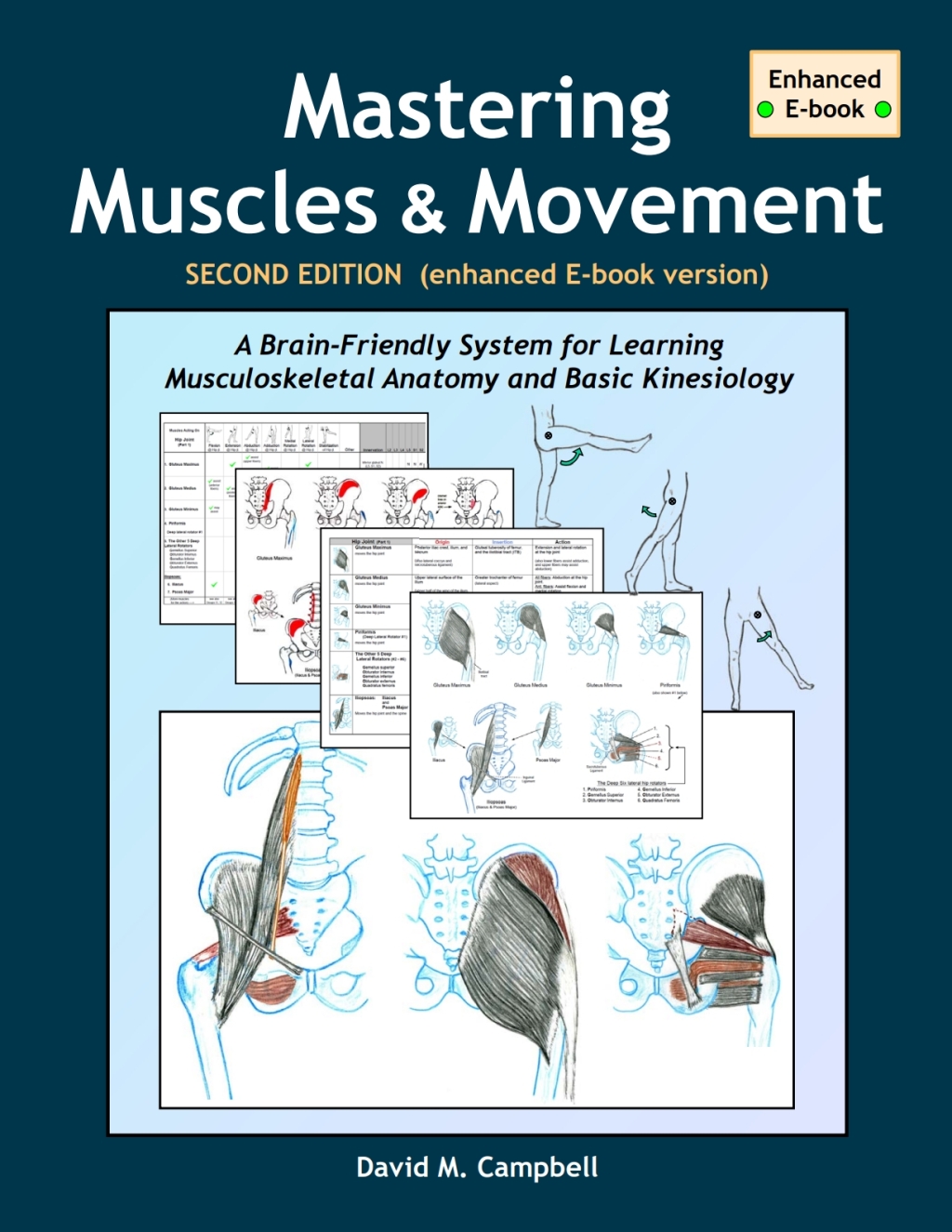


Mastering Muscles and Movement – Enhanced Ebook A Brain-Friendly System for Learning Musculoskeletal Anatomy and Basic Kinesiology 2nd Edition – PDF/EPUB Version Downloadable
$49.99
Author(s): David M. Campbell
Publisher: Bodylight Books
ISBN: 9780978866457
Edition: 2nd Edition
Mastering Muscles and Movement (MMM) is a textbook for an undergrad Kinesiology class (often called “Functional Anatomy” or “Anatomical Kinesiology”). The book is strategically organized for learning musculoskeletal anatomy from a movement viewpoint. More than 160 muscles are covered, as well as bones, bony landmarks, joints, ligaments, nerves, and kinesiology concepts. The book includes intrinsic muscles of the pelvic floor, jaw, hands, and feet, which are often overlooked in books that teach basic kinesiology.
As stated in the subtitle, the approach of this book is to be brain-friendly. The innovative arrangement of the muscle information on each page and from page-to-page enables the brain to quickly and naturally grasp the myriad details and interrelationships inherent in the study of anatomy. Please visit the companion website (studymuscles.com) for more information, sample illustrations, and excerpts from the book.
This Enhanced E-Book version of MMM contains a fixed-page replica of the 242-page physical textbook, and has 290 additional pages of supplementary material in appendices at the back of the book (see below). Extensive navigation buttons and links provide an interactive e-book for studying and memorizing anatomical and functional details for all the muscles of the body.
-
Appendix 1 – Muscle Detail Cards: Each page is a full treatment of an individual muscle, presented using the MMM brain-friendly approach (visual, verbal, relational). These “cards” are linked to the Muscle Origin/Insertion/Action tables in Chapters 4-6 of the main text, so the reader can drill down to view muscle details and then jump back to the muscle table they were studying. (175 pages)
-
Appendix 2 – Action Pair Cards: Each page displays all muscles that are involved with a specific pair of opposing actions (for example, flexion and extension of the humerus at the shoulder joint). An innovative layout of text and images deepens the reader's understanding about muscles working as synergists and antagonists when moving the body. These “cards” are linked to the Synergist & Antagonist tables in Chapters 4-6 of the main text, so the reader can jump to an Action Pair Card and then jump back to the table they were studying. (75 pages)
-
Appendix 3 – Joint Detail Cards: This provides a detailed look at the joint structure and ligaments for all the joints of the body. These “cards” are linked to the muscle group “Joints & Actions†pages in Chapters 4-6 of the main text, so the reader can optionally examine the joint details and then jump back to the muscle group page they were reading. (40 pages)
-1st-edition-%E2%80%93-pdfepub-version-downloadable-8741-yaq5g.jpg)