
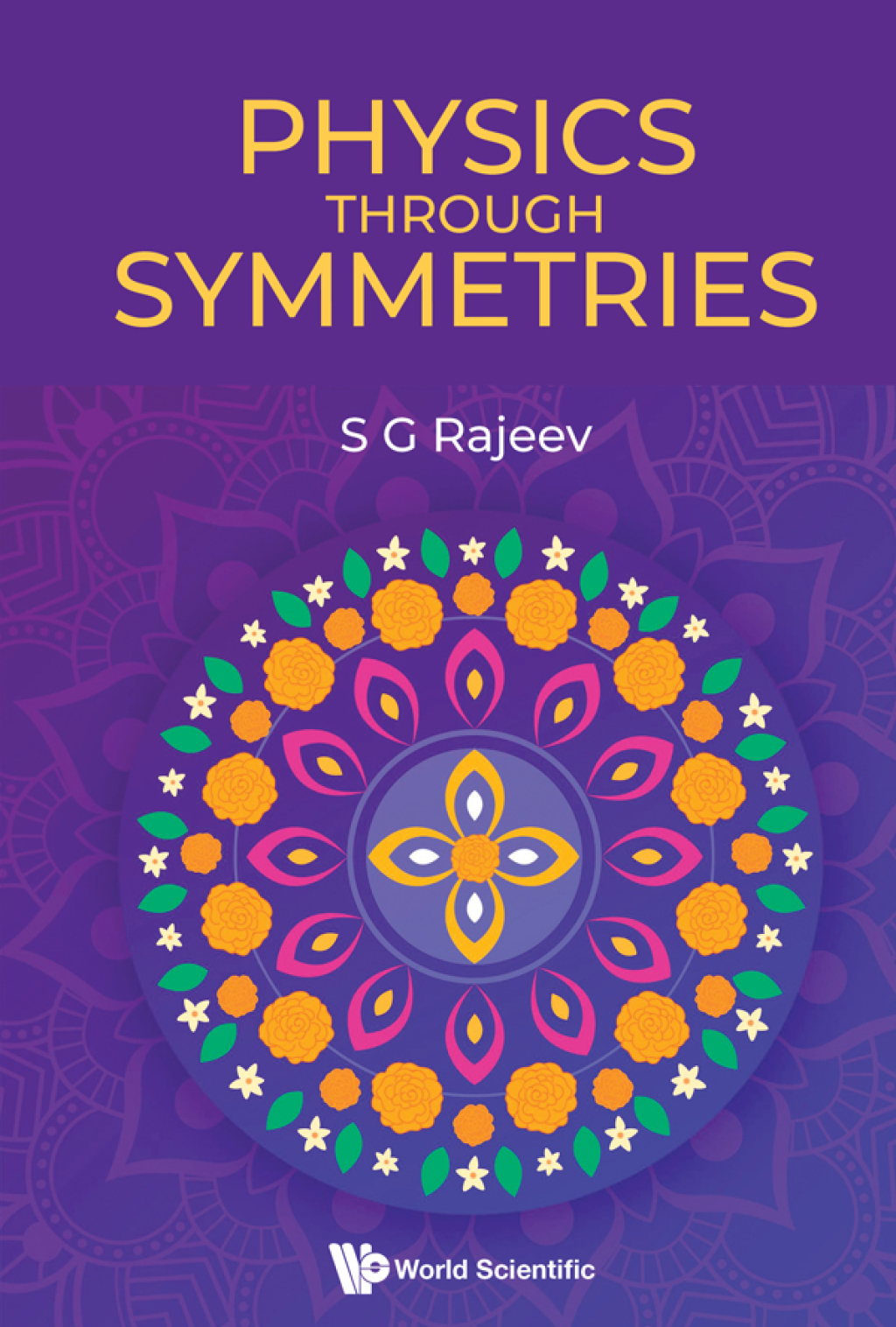


PHYSICS THROUGH SYMMETRIES – PDF/EPUB Version Downloadable
$49.99
Author(s): S G Rajeev
Publisher: WSPC
ISBN: 9789819812882
Edition:
Group Theory has been an essential tool of theoretical physics for about a century. During the early days of quantum theory, it was useful to formulate symmetries of systems and to solve for their spectra. Later it was found, in the standard model, that certain groups determine the fundamental interactions of elementary particle. It is not possible to understand modern theoretical physics without knowing group theory.
This book is an introduction to group theoretical ideas that arising in classical or quantum mechanics as well as Gield theory. The emphasis is on concepts, although some calculations are done in detail. The intended audience is a graduate student who has already learned mechanics, quantum mechanics as well as some Gield theory (e.g., Maxwell equations in their relativistic form).
Among the topics covered are the rotation group and its representations; group extensions and their relevance to spinors; the Lorentz group and relativistic wave equations; the gaussian unitary ensemble of random matrices; the quark model; the Peter-Weyl theorem for Ginite groups as well as compact Lie groups.
There are hints that future physics will need symmetries that go beyond the idea of a group. An introduction to such ‘quantum groups’ is included as well.
The book concludes with a study of a class of mechanical systems (Euler-Arnold) which include the rigid body and the ideal Gluids as examples. Some toy models that are one step away from being exactly solvable are studied as examples of chaos.
Contents:
- Preface
- Symmetry Before Physics
- Groups and Their Representations
- Lie Theory
- Rotations: SO(3) and SU(2)
- Angular Momentum
- Addition of Angular Momentum
- Isospin and Strangeness
- Bosons and Fermions
- The Ising Model
- Wave Equations
- Random Matrices
- Harmonic Analysis on Finite Groups
- Harmonic Analysis on Compact Lie Groups
- Quantum Groups
- Euler-Arnold Dynamics
- Bibliography
- Index
Readership: Advanced Graduate students in physics or applied mathematics.