
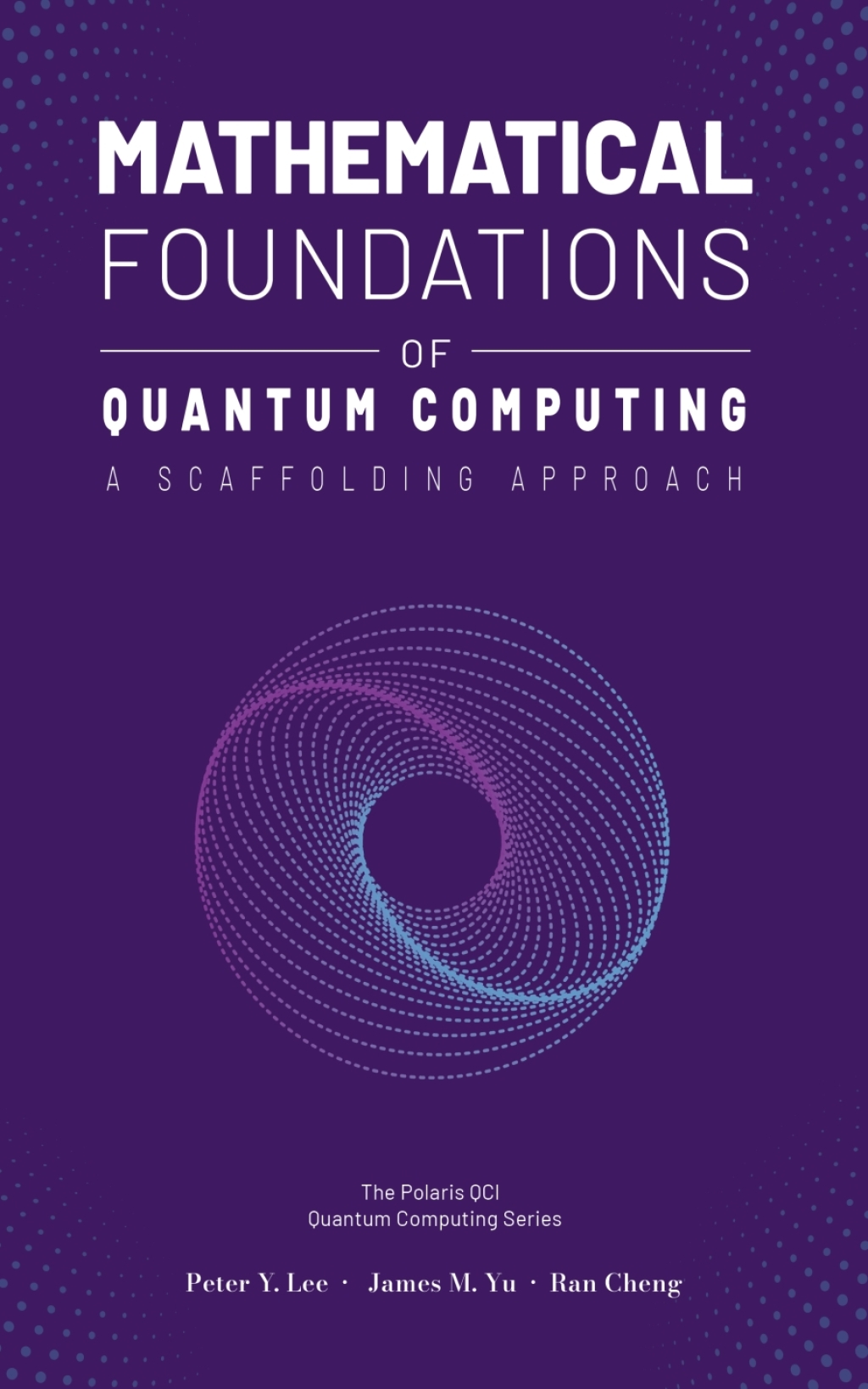

Mathematical Foundations of Quantum Computing: A Scaffolding Approach 1st Edition – PDF/EPUB Version Downloadable
$49.99
Author(s): Peter Lee, James Yu, Ran Cheng
Publisher: Polaris QCI Publishing
ISBN: 9781961880092
Edition: 1st Edition
The Scaffolding Series
This book is part of a series of textbooks designed to offer a pedagogically sound, systematic approach to teaching and learning quantum computing. The series currently includes the following titles:
• Mathematical Foundations of Quantum Computing: A Scaffolding Approach (current book)
• Quantum Computing and Information: A Scaffolding Approach
• Quantum Algorithms and Applications: A Scaffolding Approach
While each book functions as a standalone guide to its respective topic, collectively they provide a comprehensive understanding of quantum computing.
About This Book
This book is designed to provide a strong foundation in linear algebra and probability theory for quantum computing enthusiasts. It covers essential topics like Dirac notation, tensor products, trace operations, matrix decompositions, matrix functions, Pauli groups, and Markov chains—tailored for learners diving into the quantum realm.
Recognizing that diving straight into advanced concepts can be overwhelming, this book starts with a focused review of essential preliminaries like complex numbers, trigonometry, and summation rules. It serves as a bridge between traditional math education and the specific requirements of quantum computing, empowering learners to confidently navigate this fascinating and rapidly evolving field.
Editorial Reviews
Leonard Kahn, Professor and Chair, Department of Physics, University of Rhode Island
With the move toward introducing quantum computing as a first-year course, the structure of Mathematical Foundations of Quantum Computing makes it a strong contender as a text that can be used throughout an academic career. The authors have successfully designed a text that can be used at multiple stages of development, from introductory, through intermediate and graduate levels, as well as a useful reference work. From the introduction of vectors and matrices, each topic is revisited with increasing complexity, an ideal implementation of the scaffolding approach. The layout of the text, accompanied by a variety of exercises, examples, and clear graphics, advances the authors’ goal of creating a valuable learning and teaching aid. The text, along with its companion Quantum Computing and Information, deserves serious consideration by those who are designing a full-range quantum computing curriculum.
Tony Holdroyd, Retired Senior Lecturer in Computer Science and Mathematics
This book is a learned and thorough exposition of the mathematics that supports quantum computing. The authors have gone to great lengths to make it both learner-friendly and detailed while maintaining rigor. It covers topics ranging from the fundamentals of quantum mathematics to the complexities of vector and matrix algebra, as well as the probabilities central to quantum computing. The text is complemented by numerous supporting figures that effectively illustrate key concepts. Applications of quantum computing are introduced and seamlessly integrated throughout the book. This volume, along with its companion, Quantum Computing and Information – a Scaffolding Approach, is an essential addition to the bookshelf of anyone seeking a deeper understanding of quantum computing and its mathematical foundations.
From the Author
Quantum Computing and Information (QCI) represents a paradigm shift not only in computation but also in the mathematical framework necessary for advancing in the field. While linear algebra is central to QCI, the applications here extend beyond its traditional role. In quantum computing, matrices operate as dynamic tools—taking on the roles of operators and transformations—and matrix algebra, including tensor products, trace operations, matrix decompositions, and matrix functions, becomes indispensable. These sophisticated operations are essential for the mathematical precision and versatility required in quantum mechanics.
In this context, Dirac notation serves as the primary language for expressing vectors, operators, and their interactions, helping students transition smoothly into quantum mechanics. Special matrices such as Hermitian, unitary, and Pauli matrices are introduced not merely as abstract constructs but as essential building blocks that encode quantum states and govern quantum transformations, directly supporting the mathematical requirements of quantum algorithms and quantum error correction.
The probabilistic nature of quantum mechanics differs from classical probability, and this book equips students with foundational tools in probability, sampling theory, and key stochastic methods like Markov chains and MCMC. This preparation supports their understanding of probabilistic quantum algorithms and paves the way for more advanced quantum probability concepts.
Recognizing the broad mathematical prerequisites for quantum computing, we begin the book with a focused review of complex numbers, trigonometry, and summation rules, tailored specifically to quantum applications. By omitting areas such as differential equations and complex functional analysis, which, while valuable, are not essential to QC studies, this book emphasizes efficiency and accessibility, allowing students to concentrate on mastering topics directly aligned with QC.
Rather than serving as a comprehensive mathematical reference, Mathematical Foundations of Quantum Computing is intended as a streamlined, accessible guide for learners. Our goal is to bridge the gap between traditional mathematical education and the specialized demands of quantum computing, equipping readers with a solid foundation to support their future studies in quantum mechanics and quantum algorithms.
Quantum Computing and Information (QCI) represents a paradigm shift not only in computation but also in the mathematical framework necessary for advancing in the field. While linear algebra is central to QCI, the applications here extend beyond its traditional role. In quantum computing, matrices operate as dynamic tools—taking on the roles of operators and transformations—and matrix algebra, including tensor products, trace operations, matrix decompositions, and matrix functions, becomes indispensable. These sophisticated operations are essential for the mathematical precision and versatility required in quantum mechanics.
In this context, Dirac notation serves as the primary language for expressing vectors, operators, and their interactions, helping students transition smoothly into quantum mechanics. Special matrices such as Hermitian, unitary, and Pauli matrices are introduced not merely as abstract constructs but as essential building blocks that encode quantum states and govern quantum transformations, directly supporting the mathematical requirements of quantum algorithms and quantum error correction.
The probabilistic nature of quantum mechanics differs from classical probability, and this book equips students with foundational tools in probability, sampling theory, and key stochastic methods like Markov chains and MCMC. This preparation supports their understanding of probabilistic quantum algorithms and paves the way for more advanced quantum probability concepts.
Recognizing the broad mathematical prerequisites for quantum computing, we begin the book with a focused review of complex numbers, trigonometry, and summation rules, tailored specifically to quantum applications. By omitting areas such as differential equations and complex functional analysis, which, while valuable, are not essential to QC studies, this book emphasizes efficiency and accessibility, allowing students to concentrate on mastering topics directly aligned with QC.
Rather than serving as a comprehensive mathematical reference, Mathematical Foundations of Quantum Computing is intended as a streamlined, accessible guide for learners. Our goal is to bridge the gap between traditional mathematical education and the specialized demands of quantum computing, equipping readers with a solid foundation to support their future studies in quantum mechanics and quantum algorithms.