
-advanced-problems-of-phase-transition-theoryvolume-2-%E2%80%93-pdfepub-version-downloadable-9267-scqvr.jpg)
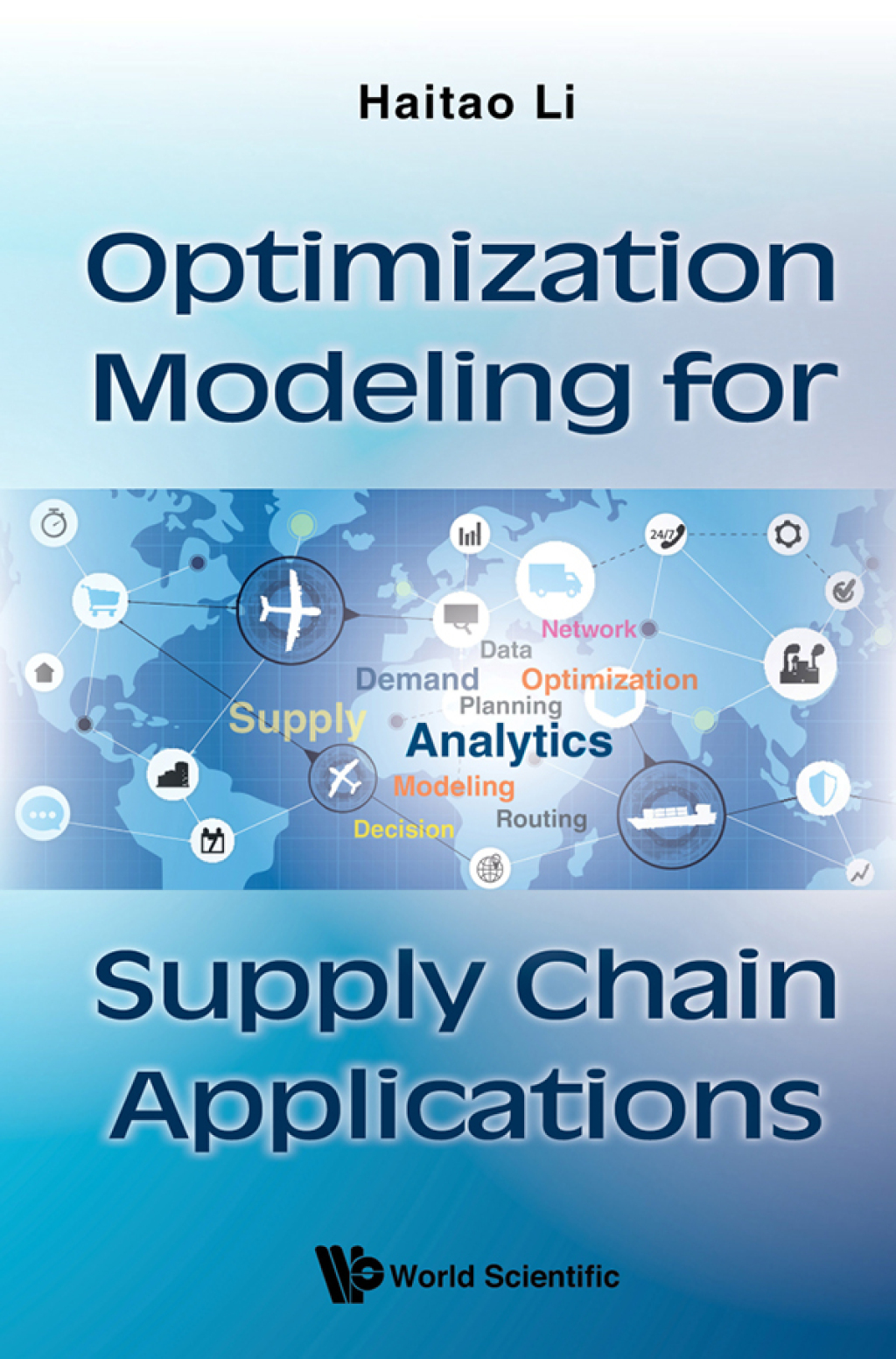
Optimization Modeling for Supply Chain Applications – PDF/EPUB Version Downloadable
$49.99
Author(s): Haitao Li
Publisher: WSPC
ISBN: 9789811259685
Edition:
How to design an efficient and cost-effective logistics network? How to plan procurement, production, and transportation to meet customer demand with minimum operating costs? How to sequence jobs through machines for on-time order completion? And how to dispatch vehicles and schedule their routes to serve customers efficiently?
Answers to these questions are key to effective and efficient supply chain operations. This book provides a systematic and comprehensive coverage of data-driven optimization modeling techniques and their applications in supply chain management. From the methodological perspective, it introduces various model building techniques including mathematical programming (linear and integer programming), network optimization, and constraint programming. From the application perspective, it covers the topics of supply chain network design, production planning, supply chain configuration, machine scheduling, and vehicle routing, among others. It also introduces the state-of-the-art optimization modeling software, the CPLEX OPL Studio, as a powerful and accessible tool for implementing the modeling techniques and solution methods in this book. Sample codes will be available upon purchase of the book.
This book is essential reading material for researchers and students in business, data analytics, industrial engineering, computer science and applied math who would like to learn optimization modeling in the context of supply chains. It is also suitable for practitioners and consultants in industry who would like to understand the behind-the-scene techniques in off-the-shelf commercial optimization software. As a textbook, it can be used for an advanced undergraduate or graduate course in supply chain management, operations management, data analytics, economics, and industrial engineering.
Contents:
- Preface
- About the Author
- List of Figures
- List of Tables
- Modeling Methodologies:
- Introduction and Overview
- Linear Programming
- Integer Programming
- Network Optimization
- Quadratic Unconstrained Binary Optimization (QUBO) Modeling
- Constraint Programming
- Supply Chain Applications:
- Supply Chain Network Design
- Production Planning
- Resource Planning
- Supply Chain Configuration
- Machine Scheduling
- Resource-Constrained Project Scheduling
- Traveling Salesman Problem and Its Variants
- Vehicle Routing Problem and Its Variants
- Credit Term Optimization
- Appendices:
- CPLEX OPL Studio
- Simplex Method for Linear Programming
- Exact Methods for Integer Programming
- A Primer in Constraint Programming Methods
- Instructions for Downloadable Electronic Slides
- References
- Index
Readership: For advanced undergraduate and graduate students, researchers and practitioners in operations research, supply chain management, operations management and industrial engineering.
‘A must read for a mathematical programming practitioner. Masterfully done, Professor Li takes an end-to-end approach for the modeling of supply chain and logistics problems, providing a comprehensive and accessible treatment of building and solving optimization models to address data-driven decision problems in supply chain management. Professor Li is the best mathematical optimization modeler I know.’ – Cipriano (Pano) Santosformer Distinguished Technologist from HP Labs
‘This is an exceptional book. It is the first to comprehensively integrate a broad range of important concepts and innovations from optimization into the treatment of supply chain management. The outcome is not merely informative but provides a perspective that significantly enriches the literature on supply chains. The preface and first chapter by themselves give a sense of the relevance of optimization modeling to supply chain management that goes beyond discussions found in previous treatments of these topics. The author, Haitao Li, exposes fundamental concepts in a clear and unpretentious way, and then progressively builds on them in multiple contexts to create a comprehensive set of principles for applying optimization modeling effectively in the supply chain setting. As a bonus, the book also covers new developments that are influencing the direction of supply chain applications, including a special chapter on models that are attracting attention in quantum computing. The book is packed with examples and illustrations. The value of this treatment for understanding goes well beyond the value of commonly encountered treatments that leave the reader with little appreciation of the concrete details of practical applications. Haitao Li’s Optimization Modeling for Supply Chain Applications is an essential part of the toolkit for anyone who wants to have a well-grounded and accessible introduction to this important area.’ – Dr Fred Glover Distinguished Professor, University of Colorado & Chief Technology Officer, OptTek Systems
‘This book contains the complete suite of prescriptive analytic tools necessary to practice supply chain analysis in 2023. Over time surely more techniques will be discovered, but at this point in time, this is the bible.’ – Dr Keith WomerProfessor Emeritus, University of Missouri – St. Louis
‘Optimization Modeling for Supply Chain Applications by Professor Haitao Li is the most-comprehensive text I have seen that combines the art and fundamentals of mathematical programming modelling with applications in supply chain management. The breadth and depth of the mathematical modeling and the various applications from network design to production scheduling and inventory control make this an excellent text for technical undergraduate majors in supply chain management, as well as for master’s degree students in analytics or supply chain management.’ – Dr Jeffrey CammInmar Presidential Chair in Analytics, Wake Forest University School of Business
Key Features:
- Introduction to optimization modeling (data-driven Prescriptive Analytics) using examples and applications in supply chains
- Focus on modeling techniques on model building rather than solution algorithms, which is often the first step in developing industry strength optimization tools and decision-support systems
- Comprehensive and systematic treatment on widely applied data-driven optimization techniques: linear programming, integer programming, network optimization and constraint programming
- Application modules for the prominent supply chain applications: network design, production planning, supply chain configuration, scheduling and routing
- Using the state-of-the-art optimization software OPL CPLEX Studio allows readers to quickly apply and implement optimization for real life problem solving