
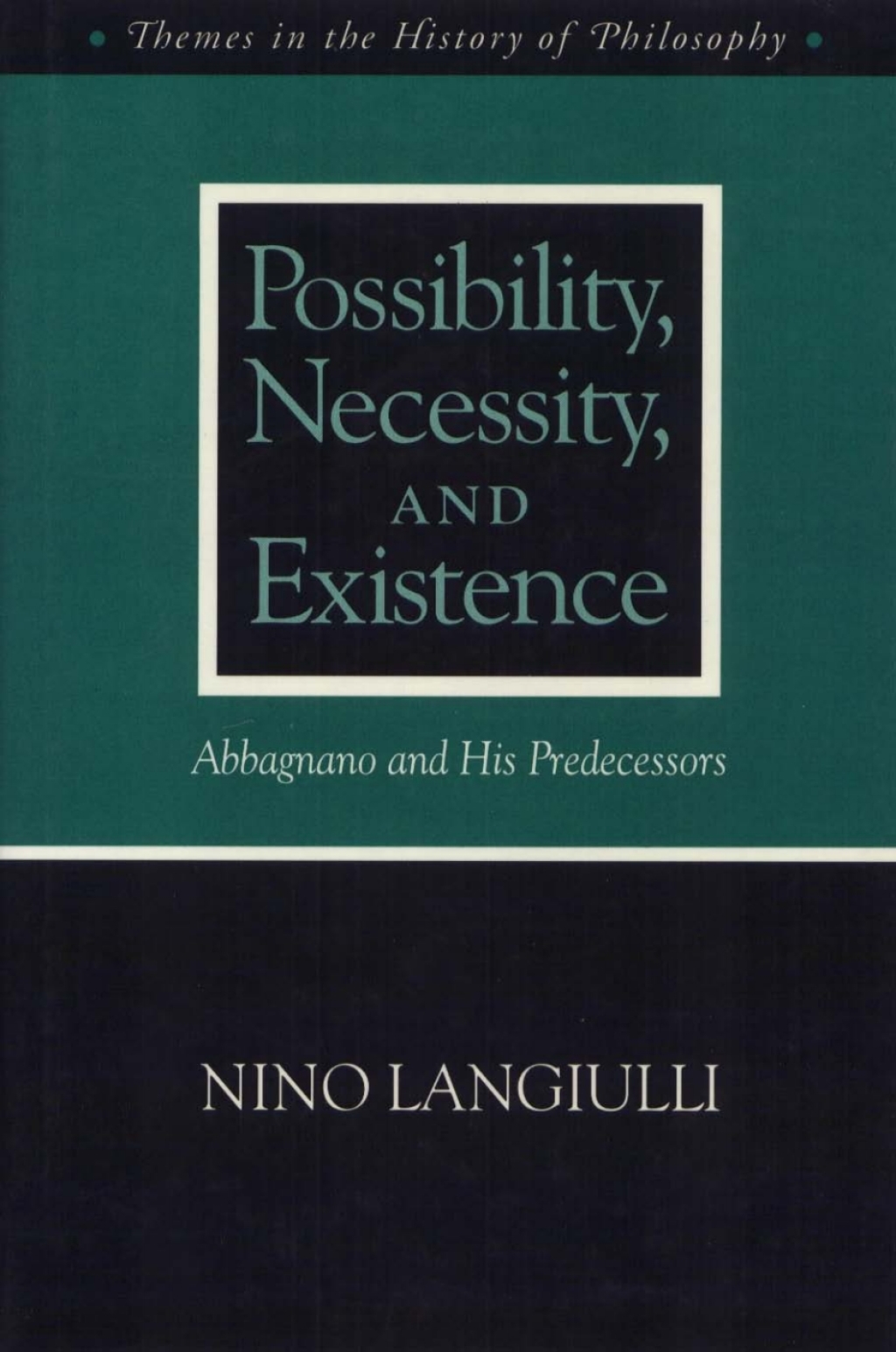
Possibility Necessity and Existence Abbagnano and His Predecessors – PDF/EPUB Version Downloadable
$49.99
Author(s): Nino Langiulli
Publisher: Temple University Press
ISBN: 9780877229216
Edition:
In this systematic historical analysis, Nino Langiulli focuses on a key philosophical issue, possibility, as it is refracted through the thought of the Italian philosopher Nicola Abbagnano. Langiulli examines Abbagnano’s attempt to raise possibility to a level of prime importance and investigates his understanding of existence. In so doing, the author offers a sustained exposition of and argument with the account of possibility in the major thinkers of the Western tradition—Plato, Aristotle, Kant, and Kierkegaard. He also makes pertinent comments on such philosophers as Diodorus Cronus, William of Ockham, Spinoza, Hobbes, and Hegel, as well as such logicians as DeMorgan and Boole. Nicola Abbagnano, who died in 1990, recently came to the attention of the general public as an influential teacher of author Umberto Eco. Creator of a dictionary of philosophy and author of a multiple-volume history of Western philosophy, Abbagnano was the only philosopher, according to Langiulli, to argue that “to be is to be possible.” Even though the concept of probability and the discipline of statistics are grounded in the concept of possibility, philosophers throughout history have grappled with the problem of defining it. Possibility has been viewed by some as an empty concept, devoid of reality, and by others as reducible to actuality or necessity—concepts which are opposite to it. Langiulli analyzes and debates Abbagnano’s treatment of necessity as secondary to possibility, and he addresses the philosopher’s conversation with his predecessors as well as his European and American contemporaries. In the series Themes in the History of Philosophy, edited by Edith Wyschogrod.
-1st-edition-%E2%80%93-pdfepub-version-downloadable-8741-yaq5g.jpg)
-1st-edition-%E2%80%93-pdfepub-version-downloadable-4292-c4gaw.jpg)