
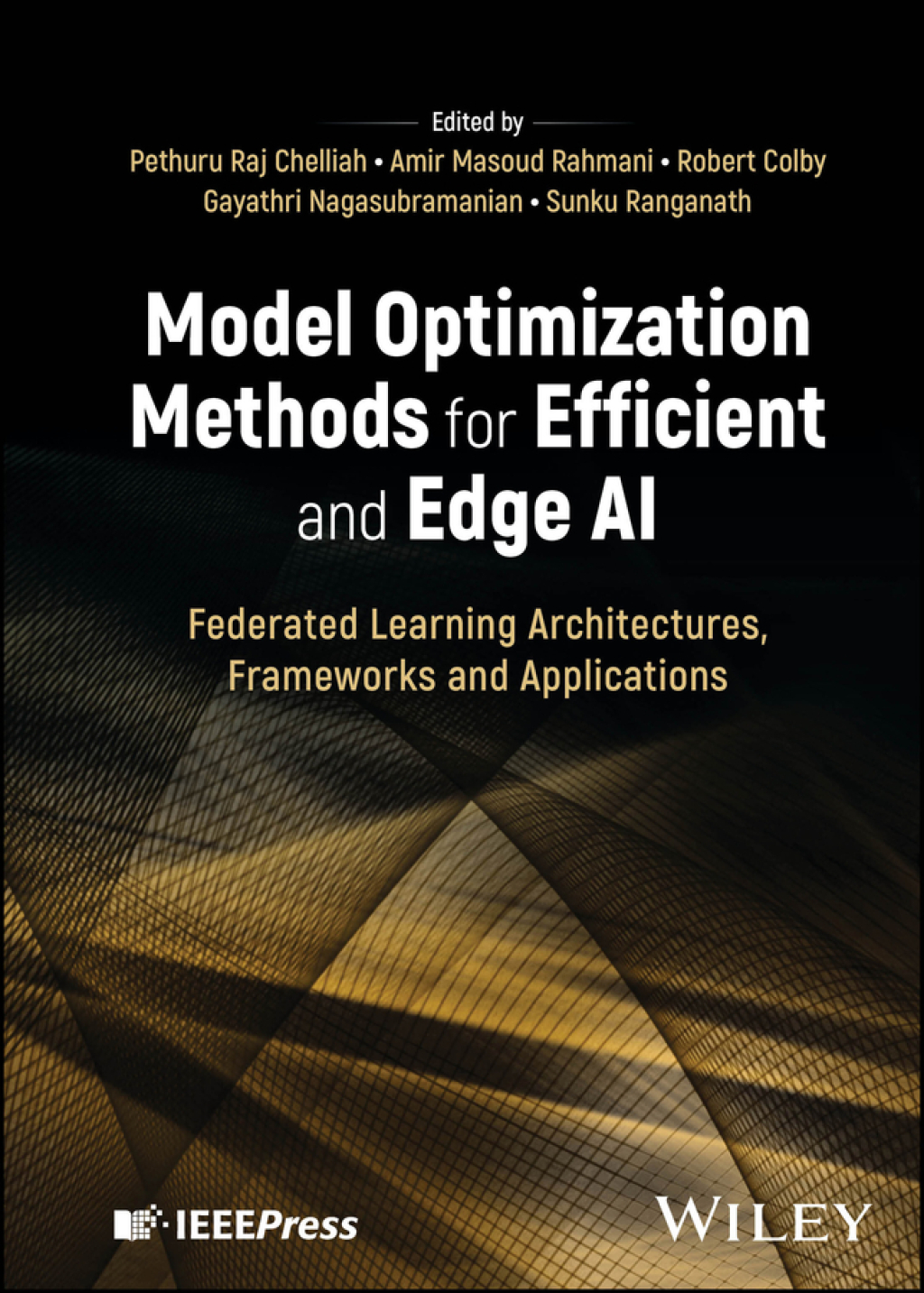
Model Optimization Methods for Efficient and Edge AI Federated Learning Architectures, Frameworks and Applications 1st Edition – PDF/EPUB Version Downloadable
$49.99
Author(s): Pethuru Raj Chelliah, Amir Masoud Rahmani, Robert Colby, Gayathri Nagasubramanian, Sunku Ranganath
Publisher: Wiley-IEEE Press
ISBN: 9781394219216
Edition: 1st Edition
Comprehensive overview of the fledgling domain of federated learning (FL), explaining emerging FL methods, architectural approaches, enabling frameworks, and applications
Model Optimization Methods for Efficient and Edge AI explores AI model engineering, evaluation, refinement, optimization, and deployment across multiple cloud environments (public, private, edge, and hybrid). It presents key applications of the AI paradigm, including computer vision (CV) and Natural Language Processing (NLP), explaining the nitty-gritty of federated learning (FL) and how the FL method is helping to fulfill AI model optimization needs. The book also describes tools that vendors have created, including FL frameworks and platforms such as PySyft, Tensor Flow Federated (TFF), FATE (Federated AI Technology Enabler), Tensor/IO, and more.
The first part of the text covers popular AI and ML methods, platforms, and applications, describing leading AI frameworks and libraries in order to clearly articulate how these tools can help with visualizing and implementing highly flexible AI models quickly. The second part focuses on federated learning, discussing its basic concepts, applications, platforms, and its potential in edge systems (such as IoT).
Other topics covered include:
- Building AI models that are destined to solve several problems, with a focus on widely articulated classification, regression, association, clustering, and other prediction problems
- Generating actionable insights through a variety of AI algorithms, platforms, parallel processing, and other enablers
- Compressing AI models so that computational, memory, storage, and network requirements can be substantially reduced
- Addressing crucial issues such as data confidentiality, data access rights, data protection, and access to heterogeneous data
- Overcoming cyberattacks on mission-critical software systems by leveraging federated learning
Written in an accessible manner and containing a helpful mix of both theoretical concepts and practical applications, Model Optimization Methods for Efficient and Edge AI is an essential reference on the subject for graduate and postgraduate students, researchers, IT professionals, and business leaders.
-1st-edition-%E2%80%93-pdfepub-version-downloadable-8741-yaq5g.jpg)