
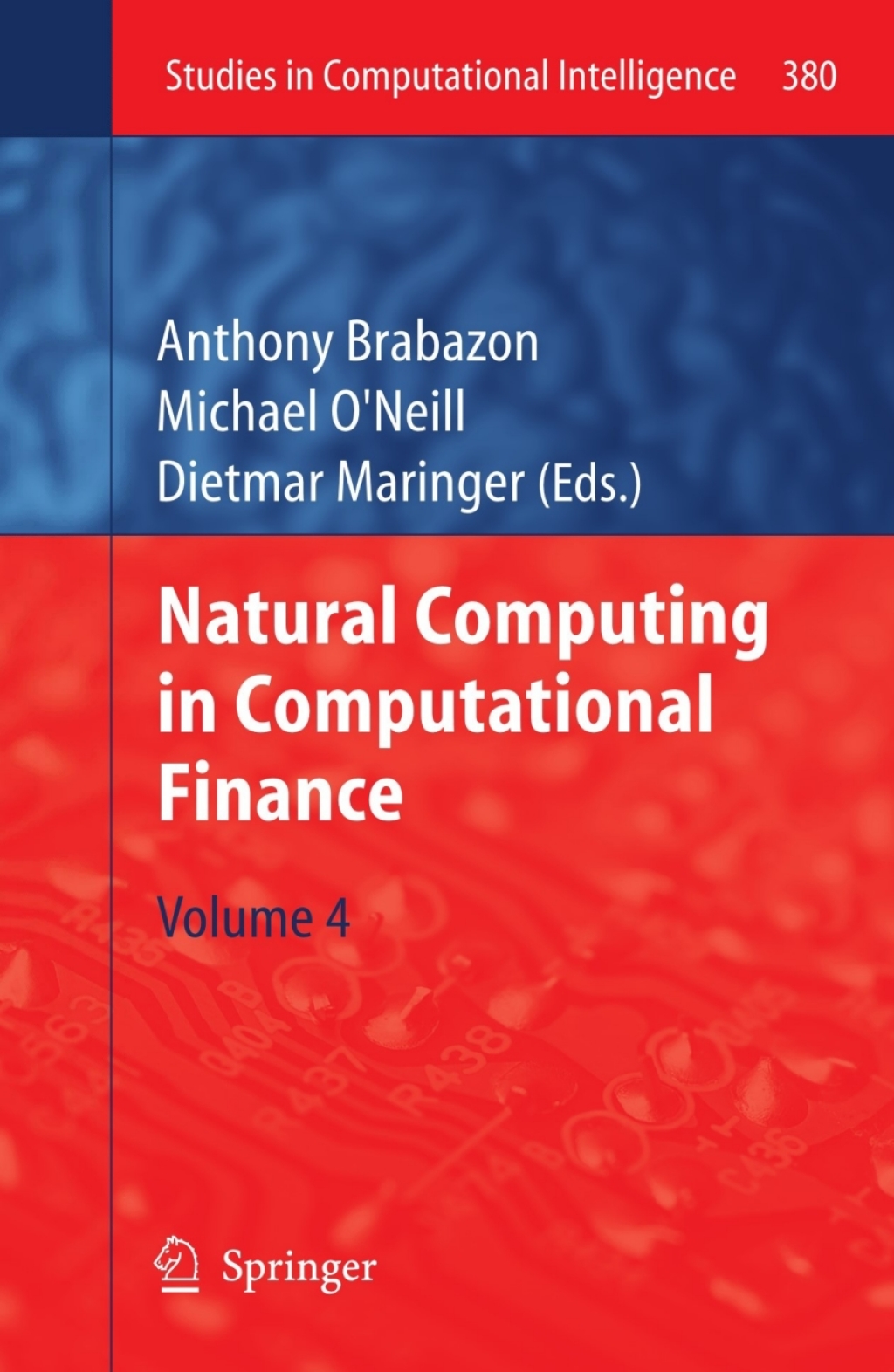

Natural Computing in Computational Finance Volume 4 1st Edition – PDF/EPUB Version Downloadable
$49.99
Author(s): Anthony Brabazon; ‎Michael O'Neill; ‎Dietmar Maringer
Publisher: Springer
ISBN: 9783642233357
Edition: 1st Edition
This book follows on from Natural Computing in Computational Finance  Volumes I, II and III.   As in the previous volumes of this series, the  book consists of a series of  chapters each of which was selected following a rigorous, peer-reviewed, selection process.  The chapters illustrate the application of a range of cutting-edge natural  computing and agent-based methodologies in computational finance and economics. The applications explored include  option model calibration, financial trend reversal detection, enhanced indexation, algorithmic trading,  corporate payout determination and agent-based modeling of liquidity costs, and trade strategy adaptation.  While describing cutting edge applications, the chapters are written so that they are accessible to a wide audience. Hence, they should be of interest  to academics, students and practitioners in the fields of computational finance and  economics.  which was selected following a rigorous, peer-reviewed, selection process.  The chapters illustrate the application of a range of cutting-edge natural  computing and agent-based methodologies in computational finance and economics. The applications explored include  option model calibration, financial trend reversal detection, enhanced indexation, algorithmic trading,  corporate payout determination and agent-based modeling of liquidity costs, and trade strategy adaptation.  While describing cutting edge applications, the chapters are written so that they are accessible to a wide audience. Hence, they should be of interest  to academics, students and practitioners in the fields of computational finance and  economics.  The applications explored include  option model calibration, financial trend reversal detection, enhanced indexation, algorithmic trading,  corporate payout determination and agent-based modeling of liquidity costs, and trade strategy adaptation.  While describing cutting edge applications, the chapters are written so that they are accessible to a wide audience. Hence, they should be of interest  to academics, students and practitioners in the fields of computational finance and  economics.  written so that they are accessible to a wide audience. Hence, they should be of interest  to academics, students and practitioners in the fields of computational finance and  economics. Â