
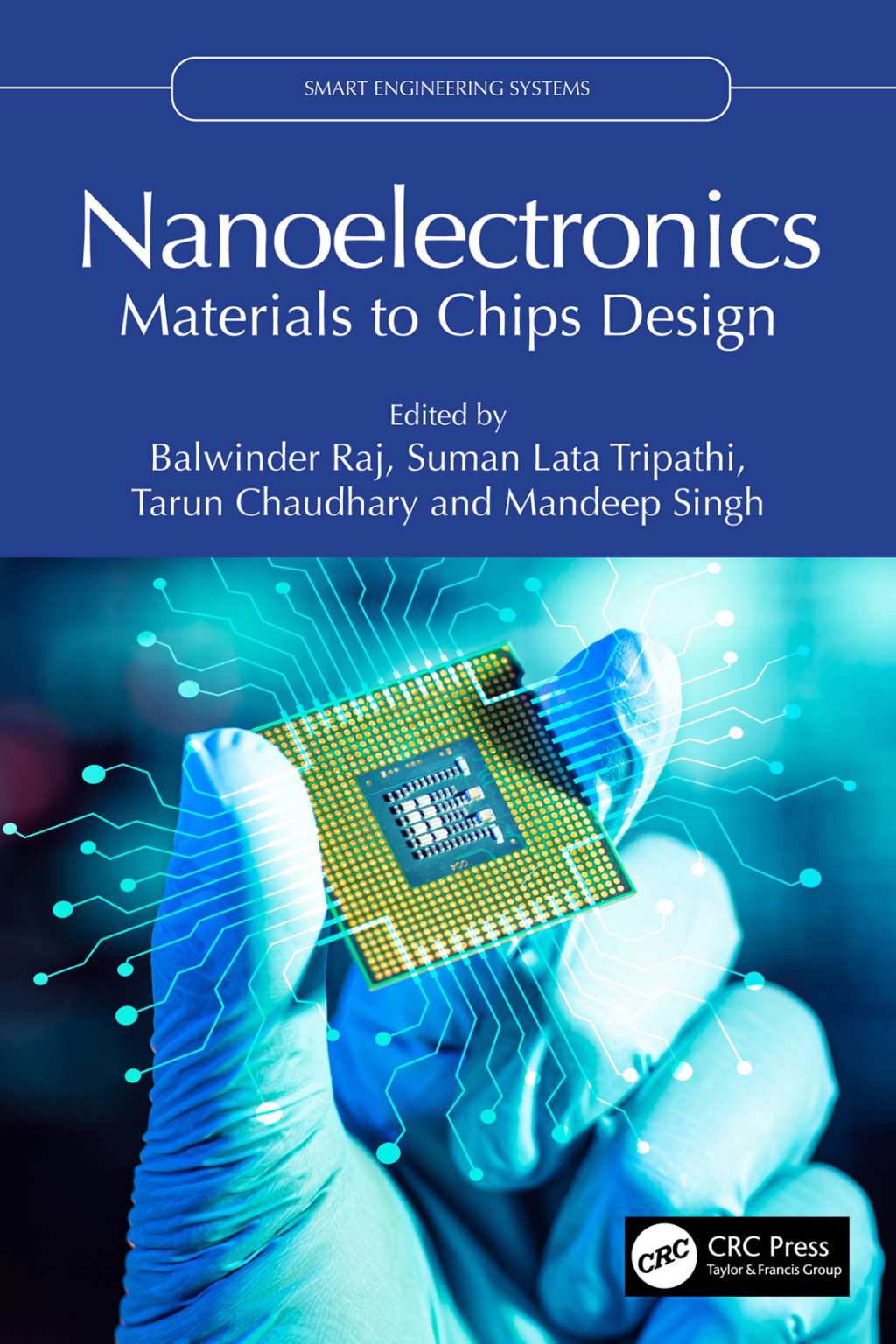
Nanoelectronics Materials to Chips Design 1st Edition – PDF/EPUB Version Downloadable
$49.99
Author(s): Balwinder Raj, Suman Lata Tripathi, Tarun Chaudhary and Mandeep Singh
Publisher: CRC Press
ISBN: 9781032745985
Edition: 1st Edition
This book exhibits a unique way of explaining nanomaterials and devices and analyzing their design parameters to meet the sub-nanoregime challenges for low-power chip design. Since process variability, device sizing, and power supply scaling are ongoing challenges in very large-scale integration (VLSI) circuit designs, this book highlights the conventional and novel nanomaterials, devices and circuits, leakage current mitigation techniques, and other important trade-offs along with exhaustive analysis. More focus has been placed throughout the book on various trade-offs for high-speed and low-power VLSI devices and circuits co-design. This book: Discusses advanced nano-semiconductor devices such as FinFET, nanowires, tunnel field-effect transistors, carbon nanotube field-effect transistors, and high-electron-mobility transistors Presents high-performance semiconductor devices at nanoscale technology nodes for the analysis of quantum effects and their impact on circuits and systems Covers power dissipation and reduction techniques for high-performance devices Explains both silicon and non-silicon devices for various applications like digital logic and analog/radio frequency applications Examines the difficulties and practical design approaches for extremely low-power analog-integrated circuits It is primarily written for senior undergraduates, graduate students, and academic researchers in the fields of electrical engineering, electronics and communications engineering, materials science, nanoscience, and nanotechnology.